WPC and SPC flooring are both types of rigid-core vinyl flooring, but they differ in core construction, underfoot comfort, rigidity, and resistance to indentation. WPC flooring generally offers a softer, more cushioned feel, while SPC flooring typically provides a harder, more rigid core with better resistance to indentation under comparable conditions. Neither is automatically better for every application. The right choice depends on the flooring specifications, installation conditions, and demands of the space.
Understanding these differences helps you compare products beyond their names and choose flooring that meets your performance and comfort requirements.
What Is WPC Flooring?
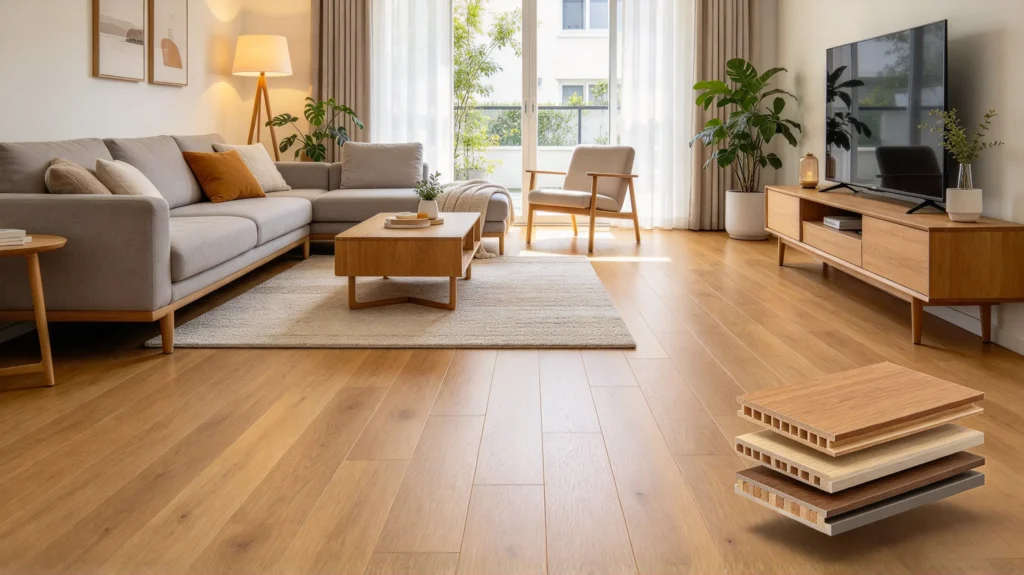
WPC stands for wood plastic composite. In the vinyl flooring market, WPC flooring typically uses a composite core formulated with polymer materials and wood-derived or other mineral fillers. Many products feature a foamed or otherwise less rigid core construction than conventional SPC flooring.
A typical WPC vinyl plank includes several layers:
- Wear layer: Helps protect the surface against everyday wear and abrasion.
- Decorative layer: Provides the wood-look, stone-look, or other visual finish.
- WPC core: Provides the plank’s structure and contributes to its underfoot feel.
- Attached underlayment: Included in some products to improve comfort and reduce sound transmission.
The exact construction varies by manufacturer and product line, so specifications should always be checked individually.
Advantages of WPC Flooring
1. Softer underfoot feel
The less rigid core construction of many WPC products creates a more cushioned feel than comparable SPC flooring. This can be appealing in bedrooms, living rooms, and other residential spaces where walking comfort matters.
2. Potentially better impact-sound comfort
WPC flooring can feel less hard underfoot, and some constructions help reduce the sound of footsteps. However, actual acoustic performance depends on the core, attached underlayment, subfloor, and installation method.
3. Comfortable residential applications
WPC can be a practical option for spaces where everyday comfort is a priority, particularly when the product also meets the required durability and moisture-performance specifications.
Limitations of WPC Flooring
1. Greater susceptibility to indentation in some products
The softer core of many WPC products can make them more susceptible to indentation under concentrated loads. Heavy furniture, narrow furniture legs, and other point loads require particular attention.
2. Performance varies by construction
The WPC label alone does not establish how well a product will resist wear, scratches, or impact. Surface coatings, wear-layer specifications, core formulation, and locking-system design all influence performance.
3. Comfort does not eliminate installation requirements
WPC flooring still requires a suitable, properly prepared subfloor. A more cushioned core does not make every product suitable for uneven surfaces or every installation condition.
What Is SPC Flooring?
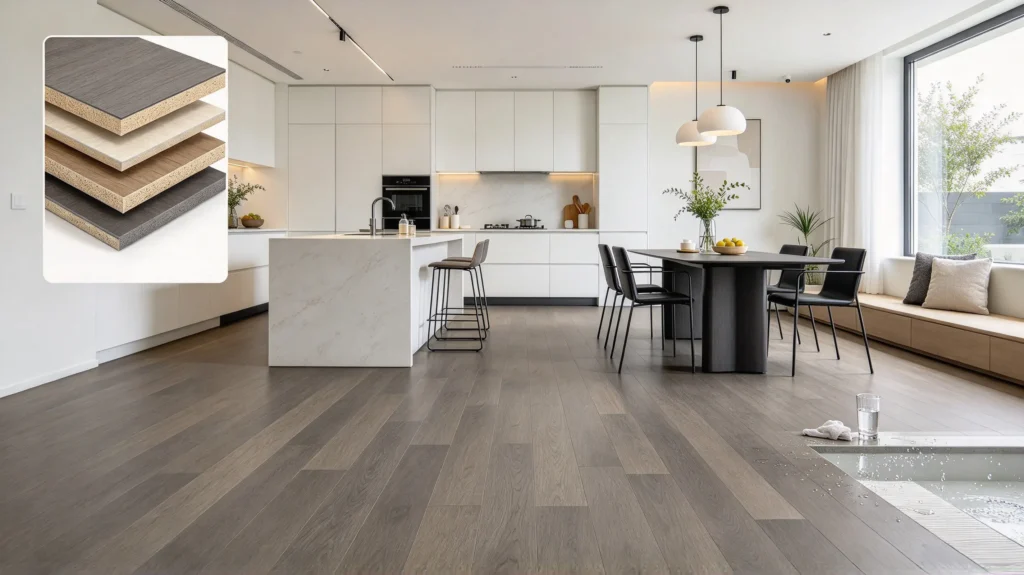
SPC stands for stone plastic composite, also commonly described as stone polymer composite. Its core typically combines PVC-based polymers with a high proportion of mineral filler, often limestone.
This formulation creates a dense, rigid core. Like WPC flooring, SPC flooring commonly includes a decorative layer, a protective wear layer, and sometimes an attached underlayment.
Its main distinguishing characteristic is rigidity rather than cushioning.
Advantages of SPC Flooring
1. Strong resistance to indentation
SPC’s dense, rigid core generally helps it resist indentation under concentrated loads compared with softer-core flooring of otherwise comparable construction. Actual performance still depends on the product’s formulation, thickness, locking system, and test results.
2. Dimensional stability
SPC flooring generally offers good dimensional stability, which can be useful in environments where temperature changes are a consideration. However, expansion, contraction, and installation tolerances remain product-specific.
3. Rigid construction
The rigid core provides a firm walking surface and supports the plank’s overall structure. This can be advantageous in areas where furniture loads and everyday traffic are important considerations.
4. Broad design options
SPC flooring is available in a range of wood-look, stone-look, and other decorative finishes. It can provide the appearance of natural materials without requiring the same maintenance as many traditional wood or stone surfaces.
Limitations of SPC Flooring
1. Firmer underfoot feel
SPC generally feels harder underfoot than comparable WPC flooring. Some products include attached underlayment to improve comfort, but this does not necessarily make them feel as cushioned as a softer-core product.
2. Subfloor preparation is critical
A rigid core does not compensate for an unsuitable or excessively uneven subfloor. Unsupported areas or surface irregularities can contribute to movement, stress on locking joints, or installation problems.
3. Rigidity does not guarantee superior surface performance
SPC’s core construction does not automatically make its surface more scratch-resistant or its wear layer more durable. These characteristics depend on the complete flooring construction and the product’s tested performance.
WPC vs. SPC Flooring: Key Differences
The most useful way to compare WPC and SPC flooring is to evaluate each characteristic separately rather than treating one material as universally superior.
| Feature | WPC Flooring | SPC Flooring |
|---|---|---|
| Core construction | Composite core, often with a less rigid or foamed structure | Dense, rigid composite core with substantial mineral filler |
| Underfoot feel | Generally softer and more cushioned | Generally firmer and harder |
| Indentation resistance | Often lower under concentrated loads | Generally higher under comparable conditions |
| Dimensional stability | Depends on core formulation and product design | Generally strong due to its rigid core |
| Footstep sound | Can provide a less hard, more cushioned feel | Can feel harder and more solid; acoustics depend on the complete system |
| Surface scratch resistance | Depends on wear layer and surface treatment | Depends on wear layer and surface treatment |
| Water resistance | Many products have waterproof cores | Many products have waterproof cores |
| Installation | Requires a suitable subfloor and product-specific installation conditions | Also requires a suitable subfloor, with particular attention to flatness and locking-joint support |
| Best selection criteria | Comfort, product specifications, and intended use | Rigidity, indentation resistance, product specifications, and intended use |
These are typical tendencies, not guarantees for every product. Different formulations, surface treatments, underlayments, and locking systems can produce different results within the same flooring category.
WPC vs. SPC Flooring: Pros and Cons
WPC Flooring
Pros
- Generally softer and more comfortable underfoot.
- Can provide a more cushioned feel in residential spaces.
- Available in a wide range of decorative styles.
- Many products feature waterproof cores.
Cons
- May be more susceptible to indentation under concentrated loads.
- Comfort and acoustic performance vary by construction.
- Still requires appropriate subfloor preparation and installation.
- Surface durability depends on the wear layer and protective finish.
SPC Flooring
Pros
- Generally offers strong resistance to indentation.
- Provides a rigid, firm walking surface.
- Typically offers good dimensional stability.
- Available in various wood-look and stone-look designs.
- Many products feature waterproof cores.
Cons
- Generally feels harder underfoot than WPC.
- Requires a suitable, sufficiently flat subfloor.
- Rigidity alone does not determine scratch resistance or overall durability.
- Sound performance depends on the complete flooring and subfloor system.
Which Is Better for Different Applications?
The best choice depends on the conditions the floor must handle. Room type is a useful starting point, but actual product specifications matter more than the label alone.
Living Rooms and Bedrooms
WPC may appeal to homeowners who prioritize a softer walking surface and a more cushioned feel. This can be useful in spaces where people spend extended periods standing or walking barefoot.
SPC is also suitable for many residential applications, particularly when indentation resistance and a firm walking surface are priorities.
How to choose: Compare comfort, surface protection, attached underlayment, furniture loads, and installation requirements rather than choosing solely by room type.
Kitchens and Moisture-Prone Areas
Both WPC and SPC vinyl flooring are available with waterproof cores, making them potential options for kitchens and other areas exposed to occasional spills.
However, a waterproof core does not automatically make the entire installed floor waterproof. Water can still enter through joints, perimeter gaps, transitions, or other vulnerable areas. Prolonged standing water and leaks may also affect the subfloor or surrounding structures.
How to choose: Verify the specific product’s moisture-performance claims, installation details, and suitability for the intended area. Consider how the floor will be protected from leaks and how water will be managed if a spill occurs.
High-Traffic Commercial Spaces
Commercial applications require a broader assessment than simply choosing SPC because it has a rigid core.
Relevant factors include:
- Expected foot traffic
- Wear-layer thickness and surface treatment
- Resistance to indentation and impact
- Locking-system strength
- Cleaning and maintenance requirements
- Product warranty and installation conditions
SPC may be a strong candidate where indentation resistance and rigidity are important. WPC may also be suitable for selected commercial applications if its specifications meet the project’s requirements.
How to choose: Evaluate the product against the actual traffic level and performance criteria. Do not assume that every SPC product is suitable for heavy commercial use.
Areas with Heavy Furniture
Furniture loads can influence the long-term appearance and performance of both types of flooring.
SPC generally offers an advantage in resistance to indentation under comparable conditions. Nevertheless, narrow furniture legs, heavy equipment, and insufficient support can create concentrated loads that challenge the flooring and its locking system.
How to choose: Check the manufacturer’s load limitations and furniture-protection recommendations. Use appropriate protective pads where required, and avoid dragging heavy furniture across the finished floor.
Spaces with Temperature Fluctuations
SPC’s rigid construction generally provides good dimensional stability, but no flooring should be assumed to tolerate unlimited temperature changes.
Direct sunlight, large temperature swings, and excessive heat can affect flooring materials and installation systems. WPC products also vary in their response to temperature.
How to choose: Review the product’s permitted installation and operating temperature ranges, expansion requirements, and restrictions on direct sunlight or other heat sources.
What Matters More Than WPC vs. SPC?
Core type is important, but it is only one part of flooring performance. Several other specifications can have a major influence on the finished floor.
1. Total Thickness vs. Wear-Layer Thickness
Total thickness describes the overall thickness of the flooring plank. Wear-layer thickness describes the protective layer above the decorative surface.
These measurements serve different purposes.
A thicker plank does not automatically have a more durable surface, and a thicker wear layer does not guarantee superior resistance to every type of scratch or impact.
When comparing products, assess total thickness, wear-layer specifications, surface treatment, and test results separately.
2. Locking-System Design
The locking system connects adjacent planks and helps maintain the integrity of the installed floor.
Weak or damaged locking joints can contribute to gaps, movement, or joint failure. Even a rigid core cannot compensate for an unsuitable locking profile or poor installation.
Compare the manufacturer’s installation instructions, locking-system requirements, and any relevant performance testing.
3. Attached Underlayment
Some WPC and SPC products include an attached underlayment. Its material and construction can affect underfoot comfort, impact-sound performance, and installation requirements.
However, adding extra underlayment is not always appropriate. Some rigid-core flooring systems restrict additional padding because excessive cushioning can increase movement and stress on the locking joints.
Always follow the flooring manufacturer’s instructions.
4. Subfloor Preparation
Subfloor conditions are essential for both WPC and SPC flooring.
Before installation, the substrate must meet the product’s requirements for flatness, stability, cleanliness, and moisture conditions. Uneven areas can create unsupported sections and increase stress on the joints.
SPC’s rigidity does not make it a universal solution for uneven floors, and WPC’s softer core does not eliminate the need for proper preparation.
5. Warranty and Installation Requirements
A warranty should be reviewed alongside the installation instructions, not in isolation.
Check whether the warranty covers the intended application and what conditions apply to moisture, temperature, subfloor preparation, furniture loads, and installation methods.
The product’s documented suitability for the intended environment is more useful than a general claim that WPC or SPC is suitable for every space.
Is WPC or SPC Flooring More Waterproof?
Both WPC and SPC vinyl flooring are commonly available with waterproof cores. Neither category should automatically be considered superior in overall water protection based on its core material alone.
It is important to distinguish three things:
- Waterproof core: The core material itself does not readily absorb water.
- Water-resistant surface or construction: The product can resist moisture to the extent specified by the manufacturer.
- Waterproof installed floor system: The complete installation provides the required protection against water reaching the substrate or surrounding structure.
Even when a plank has a waterproof core, water may pass through joints, edges, transitions, or penetrations. The installed floor may therefore need additional protection depending on the application.
For kitchens, laundry rooms, and other areas where leaks are possible, check the product’s moisture specifications and installation details rather than relying on the WPC or SPC label.
How to Choose Between WPC and SPC Flooring
Use the following decision process to narrow your options.
Choose WPC as a candidate if:
- A softer, more cushioned feel is a priority.
- The product’s indentation resistance meets the expected furniture loads.
- Its moisture, wear, and installation specifications fit the space.
Choose SPC as a candidate if:
- A firm, rigid walking surface is preferred.
- Resistance to indentation is an important consideration.
- The product’s wear layer, locking system, and other specifications meet the intended use.
Compare both options carefully if:
- The floor will experience heavy traffic or concentrated loads.
- The area is exposed to temperature changes or moisture.
- Acoustic performance is important.
- The project has specific installation or warranty requirements.
The final decision should be based on the complete product construction and documented performance, not simply the material name or total thickness.
FAQs
Is WPC better than SPC flooring?
Neither is universally better. WPC generally offers a softer, more cushioned feel, while SPC typically provides a more rigid core and stronger resistance to indentation under comparable conditions. The better option depends on the intended application and product specifications.
Which is more durable, WPC or SPC?
SPC generally has an advantage in core rigidity and resistance to indentation, but overall durability also depends on the wear layer, surface treatment, locking system, installation, and maintenance. A product’s performance specifications are more informative than its core type alone.
Which is more comfortable underfoot?
WPC generally feels softer and more cushioned than SPC. However, attached underlayment, plank construction, and the subfloor can also affect comfort.
Is SPC more scratch-resistant than WPC?
Not necessarily. Scratch resistance depends heavily on the surface coating, wear layer, and overall product construction. SPC’s rigid core may help with indentation resistance, but it does not automatically make the surface more scratch-resistant.
Can both WPC and SPC flooring be waterproof?
Many products in both categories have waterproof cores. However, the entire installed floor is not necessarily waterproof because moisture can enter through joints, edges, and other openings. Always check the specific product’s claims and installation requirements.
Does thicker flooring mean better quality?
No. Total thickness is only one specification. Wear-layer thickness, core construction, locking-system design, surface treatment, and installation requirements all affect performance. Compare each factor according to the demands of the project.
Can WPC and SPC flooring be used in commercial spaces?
Both can be considered for selected commercial applications, provided the product meets the required performance standards and manufacturer’s recommendations. Traffic levels, furniture loads, wear-layer specifications, maintenance, and warranty conditions should all be assessed.
Conclusion
WPC and SPC flooring differ mainly in core construction, rigidity, and underfoot feel. WPC generally emphasizes cushioning and comfort, while SPC typically emphasizes rigidity and resistance to indentation.
Neither core type guarantees superior overall performance. Compare the complete flooring construction, wear layer, locking system, installation requirements, and documented specifications to find the option that best fits your space.
Comparing flooring options for your project? Contact timmy.wu@timotechs.com to discuss your requirements and explore suitable SPC flooring solutions from TIANAN New Materials.