Non-woven wallpaper is a wallcovering made with a non-woven base, typically combining cellulose and synthetic fibers. It is known for good dimensional stability, tear resistance, breathability, and relatively easy installation. However, whether it is the right choice for a particular room depends on factors such as moisture exposure, surface performance, durability, maintenance, and budget.
What Is Non-Woven Wallpaper?
Non-woven wallpaper is made using a non-woven backing or base rather than traditional paper alone. Its structure commonly combines cellulose fibers with synthetic fibers, which are bonded together instead of being woven into a fabric.
The term “non-woven” describes how the fibers are formed into the material. It does not mean that the wallpaper is simply made from fabric, nor does it automatically describe the wallpaper’s surface finish.
This distinction is important because a non-woven wallpaper can have different surface treatments, including printed or coated decorative surfaces. As a result, two non-woven wallpapers can have noticeably different levels of washability, moisture resistance, thickness, and durability.
What Does “Non-Woven” Mean?
Unlike woven materials, where fibers or yarns are interlaced to form a fabric, non-woven materials are produced by bonding fibers together through mechanical, chemical, thermal, or combined processes.
For wallpaper, this creates a stable base that can support a decorative surface while offering several practical advantages during installation and everyday use.
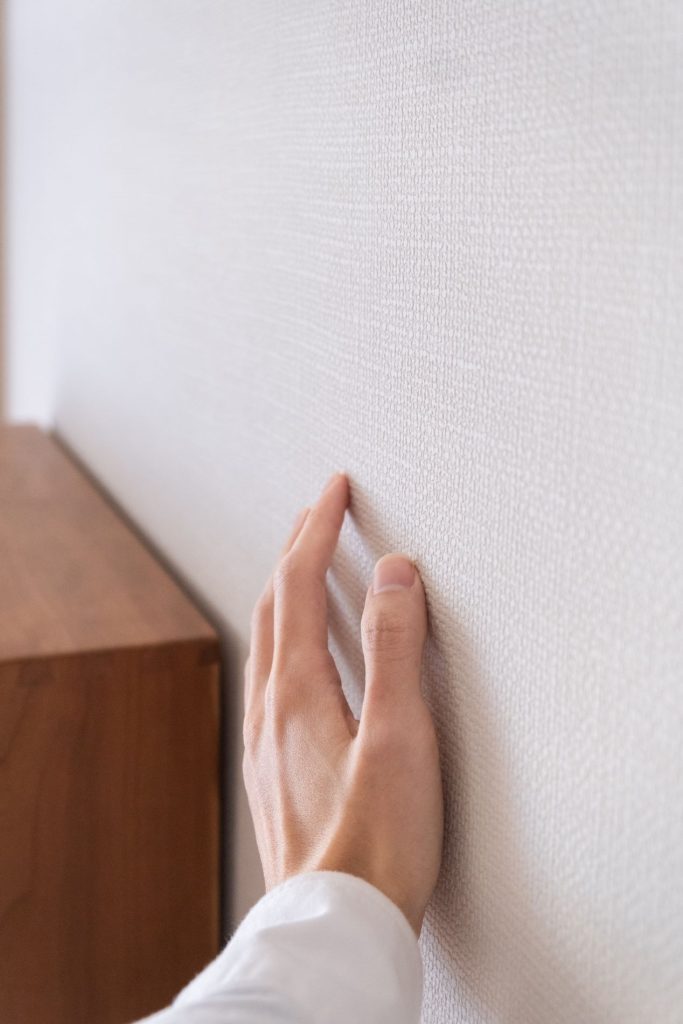
What Is Non-Woven Wallpaper Made Of?
The exact construction varies by manufacturer and product, but non-woven wallpaper commonly contains a combination of:
- Cellulose fibers, often derived from wood pulp
- Synthetic fibers, which can contribute to strength and dimensional stability
- Decorative surface layers, depending on the design and product type
- Printing or protective finishes, where applicable
Because manufacturers can use different formulations and layer structures, the term non-woven wallpaper does not refer to one standardized thickness or composition.
This is also why the performance of one non-woven wallpaper should not automatically be applied to every product in the category.
What Are the Advantages of Non-Woven Wallpaper?
Non-woven wallpaper has become popular partly because its construction addresses several practical limitations associated with traditional paper wallpaper.
1. Easier Installation
Many non-woven wallpapers are designed for paste-the-wall installation. Instead of applying adhesive to the back of the wallpaper and waiting for it to absorb the paste, the adhesive is typically applied directly to the prepared wall.
The dry wallpaper can then be positioned on the wall and adjusted before being smoothed into place.
This can make installation more straightforward, particularly for large-scale wallcovering projects.
2. Good Dimensional Stability
Non-woven wallpaper generally has good dimensional stability compared with some traditional paper wallpapers.
This means it is less likely to undergo significant expansion and contraction when exposed to adhesive and normal changes in indoor conditions.
Better dimensional stability can make pattern alignment and installation easier.
3. Tear Resistance
The fiber structure can provide greater resistance to tearing than conventional lightweight paper wallpaper.
This does not mean non-woven wallpaper cannot be damaged. Sharp objects, excessive force, or improper installation can still cause tears or surface damage.
4. Breathability
Many non-woven wallpaper constructions allow moisture vapor to pass through the material more readily than some less breathable wallcoverings.
However, breathability should not be confused with waterproofing.
A breathable wallpaper can still be unsuitable for areas exposed to direct water.
5. Easier Removal
Many non-woven wallpapers can be removed relatively easily when it is time to redecorate.
Depending on the product construction and adhesive used, the wallpaper may be removable in large sections rather than requiring extensive soaking and scraping.
The exact removal method still depends on the product and installation.
6. Wide Design Options
Non-woven bases can support many decorative finishes, making them available in:
- Solid colors
- Floral patterns
- Geometric designs
- Textured finishes
- Wood-inspired patterns
- Stone-inspired designs
- Custom printed graphics
This makes them suitable for both residential and commercial interiors.
What Are the Disadvantages of Non-Woven Wallpaper?
Non-woven wallpaper has clear advantages, but it is not automatically the best wallcovering for every situation.
It is not inherently waterproof
The non-woven base itself should not be treated as a waterproof material. Moisture resistance depends heavily on the complete construction and surface finish.
It can cost more than basic paper wallpaper
Non-woven products may have a higher material cost than basic paper wallpaper, although pricing varies considerably depending on the design, printing process, construction, brand, and finish.
Surface performance varies
A non-woven backing does not tell you whether the finished wallpaper is highly washable, scrub-resistant, stain-resistant, or suitable for humid environments.
Those properties depend on the surface construction.
Installation still requires wall preparation
Paste-the-wall installation does not eliminate the need for a properly prepared substrate. Uneven, dirty, damp, or poorly primed walls can affect the finished result.
Complex patterns may require more care
Large patterns, murals, and designs requiring precise matching can require careful measurement and professional installation to achieve consistent alignment.
Non-Woven vs. Vinyl Wallpaper: What’s the Difference?
This comparison requires some clarification because “non-woven” and “vinyl” can describe different parts of a wallpaper’s construction.
Non-woven generally refers to the base or backing, while vinyl commonly refers to the surface material or coating.
Therefore, they are not always completely separate categories.
A wallpaper can, for example, have a non-woven backing with a vinyl surface.
| Feature | Non-Woven Construction | Vinyl Surface |
|---|---|---|
| What it describes | Usually the base/backing | Usually the surface/coating |
| Main characteristics | Stability, strength, breathability | Water resistance, washability, surface durability |
| Moisture performance | Depends on the complete construction | Generally higher when properly constructed |
| Cleaning | Depends on surface finish | Often easier to clean |
| Installation | Many products support paste-the-wall | Depends on construction |
So when comparing wallpaper, look beyond the product label.
If moisture resistance or frequent cleaning is important, check the surface construction and manufacturer’s performance specifications rather than assuming that “non-woven” alone determines the result.
Woven vs. Non-Woven Wallpaper: What’s the Difference?
The main difference is how the fibers are assembled.
Woven Materials
Woven materials are made by interlacing yarns or fibers into a fabric structure.
Non-Woven Materials
Non-woven materials are produced by bonding fibers together without traditional weaving.
For wallpaper, this difference affects the material’s structure and handling characteristics.
Non-woven wallpaper is generally selected for its combination of dimensional stability, strength, and ease of installation, while woven textile wallcoverings may be chosen for their distinctive fabric appearance and tactile qualities.
Therefore, non-woven wallpaper should not be confused with textile wallpaper simply because both contain fibers.
Is Non-Woven Wallpaper Waterproof?
No. Non-woven wallpaper is not inherently waterproof.
This is one of the most important distinctions to understand when choosing wallpaper for a moisture-prone room.
A non-woven base can be breathable and moisture-tolerant, but that does not mean it can withstand direct and continuous water exposure.
The actual performance depends on the complete wallpaper construction.
Can Non-Woven Wallpaper Be Used in a Bathroom?
It can be suitable for some bathroom applications, but it should not automatically be used in areas exposed to direct water.
For example, a non-woven wallpaper may be appropriate for a bathroom wall with normal humidity and occasional splashes if the specific product is rated for that environment.
A shower wall is different. Continuous direct water exposure requires a wallcovering or wall system specifically designed for wet conditions.
If the wallpaper has a water-resistant or vinyl surface, its performance may be different from that of a conventional non-woven decorative surface. Always check the manufacturer’s application recommendations.
How Durable Is Non-Woven Wallpaper?
Non-woven wallpaper can be durable, but its lifespan depends on the complete product construction and the environment in which it is installed.
Important factors include:
- Surface material
- Surface coating
- Traffic level
- Cleaning frequency
- UV exposure
- Humidity
- Installation quality
- Wall condition
A non-woven backing can provide good dimensional stability and tear resistance, but it does not automatically make every wallpaper highly abrasion- or stain-resistant.
For high-traffic commercial interiors, look for products with performance characteristics appropriate for the intended environment rather than selecting based solely on the non-woven backing.
Is Non-Woven Wallpaper More Expensive?
Non-woven wallpaper is often more expensive than basic paper wallpaper, but there is no fixed price difference.
The final cost can vary depending on:
- Fiber composition
- Wallpaper thickness
- Printing method
- Pattern complexity
- Surface coating
- Brand
- Customization
- Installation requirements
A premium non-woven wallpaper with a specialized surface can cost considerably more than a basic non-woven product.
Therefore, compare the complete product construction and performance rather than using the backing material alone to judge value.
Is Non-Woven Material Good?
Non-woven material is a good option when dimensional stability, strength, easier installation, and design flexibility are important.
It can be particularly useful for:
- Living rooms
- Bedrooms
- Hallways
- Offices
- Hospitality interiors
- Commercial decorative spaces
However, “good” depends on the application.
If the priority is direct water resistance, for example, a standard non-woven wallpaper may not be the right solution. A product with an appropriate water-resistant surface or a purpose-designed wet-area wallcovering may be more suitable.
Is Non-Woven Wallpaper Thick?
There is no single standard thickness for non-woven wallpaper.
Thickness varies according to:
- Fiber composition
- Number of layers
- Surface coating
- Printing process
- Texture
- Product design
A thicker wallpaper is not automatically a higher-quality wallpaper.
For example, a thinner product with good dimensional stability and a durable surface may perform better for a particular application than a thicker product with a less suitable construction.
When comparing products, consider thickness together with surface durability, backing strength, application, and installation requirements.
How to Use Non-Woven Wallpaper
Many non-woven wallpapers are designed for paste-the-wall installation, which simplifies the basic installation process.
1. Prepare the Wall
The wall should be:
- Clean
- Dry
- Smooth
- Stable
- Properly primed where required
Repair cracks, holes, and significant surface irregularities before installation.
2. Measure and Plan
Measure the wall and determine the position of each wallpaper panel or roll.
For patterned wallpaper, account for the pattern repeat before cutting.
3. Apply the Adhesive
For products designed for paste-the-wall installation, apply the recommended adhesive evenly to the wall.
Do not assume that every non-woven wallpaper uses exactly the same adhesive or installation method.
4. Position the Wallpaper
Place the dry wallpaper onto the prepared wall and align the pattern or edges carefully.
5. Smooth the Surface
Use an appropriate wallpaper brush, smoother, or roller to remove air pockets and ensure good contact.
Avoid excessive pressure that could damage the surface.
6. Trim the Edges
Once the wallpaper is correctly positioned, carefully trim excess material around corners, ceilings, floors, and openings.
Always follow the manufacturer’s installation instructions, as adhesive requirements, seam treatment, substrate preparation, and removal methods can vary between products.
Which Type of Wallpaper Is Best?
There is no single wallpaper type that is best for every room.
The right choice depends on what the wall needs to withstand.
| Priority | Wallpaper Characteristics to Consider |
|---|---|
| Easy installation | Non-woven / paste-the-wall construction |
| Breathability | Suitable breathable construction |
| Frequent cleaning | Washable or more durable surface |
| High moisture exposure | Water-resistant or purpose-designed wet-area surface |
| Maximum design flexibility | Printed decorative wallpaper |
| Textile appearance | Woven or textile wallcovering |
| Easy future replacement | Removable construction |
For most interior rooms, non-woven wallpaper is a versatile option. For bathrooms, kitchens, commercial spaces, or high-traffic areas, however, the surface performance and application rating become increasingly important.
Is Non-Woven Wallpaper Right for Your Space?
The best way to decide is to start with the environment rather than the material name.
Living Rooms and Bedrooms
Non-woven wallpaper is generally well suited to these spaces, particularly when design flexibility and easy installation are priorities.
Hallways
Its dimensional stability and range of decorative finishes make it a practical option for many hallway applications.
Offices and Commercial Interiors
The appropriate choice depends on traffic levels, cleaning requirements, and required surface durability.
Bathrooms
Non-woven wallpaper can work in suitable bathroom areas when the specific product is intended for humid environments. However, standard non-woven wallpaper should not automatically be treated as waterproof.
Direct Shower Areas
Direct and continuous water exposure requires a wallcovering or wall system specifically designed for wet areas. A standard non-woven wallpaper should not be selected simply because it is described as breathable or moisture-tolerant.
FAQs
Non-woven wallpaper is a wallcovering made with a non-woven base, commonly combining cellulose and synthetic fibers. The fibers are bonded rather than traditionally woven. It is valued for dimensional stability, tear resistance, breathability, and relatively easy installation.
Non-woven wallpaper can be better than traditional paper wallpaper when easier installation, dimensional stability, and strength are priorities. However, it is not universally better. The best option depends on the room, moisture exposure, cleaning requirements, surface performance, appearance, and budget.
Non-woven usually describes the wallpaper’s base or backing, while vinyl generally describes its surface or coating. They are not always mutually exclusive categories. A wallpaper can have a non-woven backing with a vinyl surface, so the complete construction should be checked when comparing products.
Non-woven wallpaper is often more expensive than basic paper wallpaper, but prices vary by material composition, printing method, design, surface finish, brand, and customization. The backing material alone does not determine the final price.
Yes. Many non-woven wallpapers are specifically designed for paste-the-wall installation. The adhesive is applied directly to the prepared wall before the dry wallpaper is positioned. Always check the manufacturer’s installation instructions for the specific product.
Non-woven wallpaper can offer good durability, dimensional stability, and tear resistance. Its overall lifespan depends on the surface construction, installation, cleaning, humidity, UV exposure, and traffic level. The non-woven backing alone does not determine the durability of the finished wallpaper.
Some non-woven wallpapers can be used on bathroom walls where humidity and occasional splashes are expected, provided the product is suitable for that environment. Standard non-woven wallpaper should not be assumed to be waterproof or suitable for direct shower exposure.
There is no standard thickness for all non-woven wallpaper. Thickness varies according to fiber composition, layers, surface finish, texture, and manufacturing process. Thickness should be considered together with surface durability and intended application rather than used as the sole indicator of quality.
Conclusion
Non-woven wallpaper offers a practical combination of dimensional stability, strength, breathability, design flexibility, and relatively easy installation. However, it is not automatically waterproof or suitable for every environment.
When choosing a non-woven wallpaper, look beyond the name of the material and consider its surface construction, moisture resistance, durability, installation requirements, and intended application.
Looking for the right wallpaper solution for your project? Contact us at timmy.wu@timotechs.com to discuss your requirements and explore suitable wallcovering options.