The best waterproof flooring for a bathroom depends on more than whether the material can resist water. A suitable bathroom floor should also provide wet-slip resistance, tolerate humidity, withstand daily use, and be installed correctly around edges and joints. Porcelain tile, sheet vinyl, LVT/LVP, and SPC flooring are among the most practical options, but each has different strengths and limitations.
What Should Bathroom Flooring Be Able to Handle?
Bathrooms expose flooring to more moisture than most other rooms. Water can come from showers, bathtubs, sinks, wet feet, cleaning, and occasional spills, while regular changes in humidity add another challenge.
When choosing bathroom flooring, consider these factors:
Water Resistance
The flooring material should tolerate frequent exposure to water without swelling, warping, delaminating, or otherwise degrading.
However, it is important to distinguish between waterproof flooring material and a completely waterproof floor installation. A waterproof plank can resist water itself, but poorly sealed joints, edges, or penetrations can still allow water to reach the subfloor.
Wet-Slip Resistance
A bathroom floor can become slippery when wet, so waterproof performance alone is not enough. Surface texture, finish, and the product’s tested slip-resistance performance should also be considered.
A floor designed for a bathroom should be evaluated for its intended wet-area application rather than assuming that every waterproof product provides the same level of traction.
Humidity Resistance
Bathrooms can experience repeated cycles of high humidity and drying. Flooring should remain dimensionally stable under the environmental conditions specified by the manufacturer.
Easy Maintenance
Bathroom floors need regular cleaning. Smooth, non-porous surfaces are generally easier to maintain because they do not readily absorb everyday spills and moisture.
Comfort Underfoot
Tile can be durable and highly moisture-resistant, but it is hard and can feel cold under bare feet. Vinyl flooring generally provides a softer, warmer feel and can be more comfortable for everyday bathroom use.
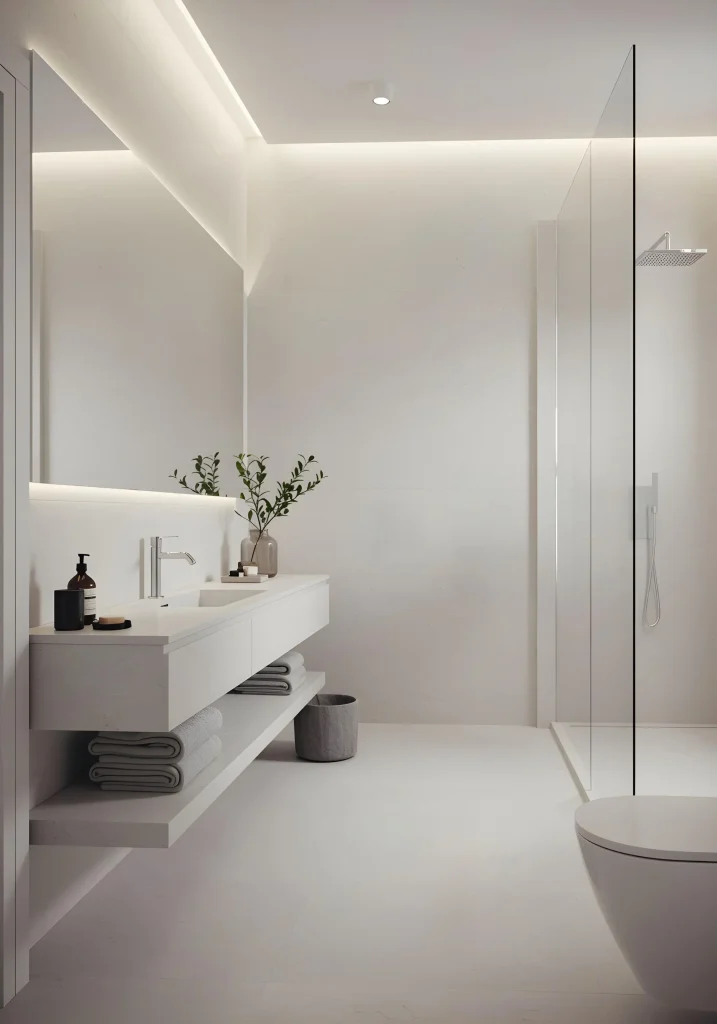
Best Waterproof Flooring Options for Bathrooms
There is no single flooring material that is best for every bathroom. The right choice depends on the room’s moisture exposure, design requirements, installation method, maintenance expectations, and budget.
1. Porcelain and Ceramic Tile
Porcelain and ceramic tile remain traditional choices for bathrooms.
Porcelain is particularly well suited to wet environments because of its low water absorption and high durability. It also offers a broad range of colors, patterns, textures, and stone-look designs.
Advantages:
- Excellent moisture resistance
- High durability
- Wide range of designs
- Suitable for radiant heating systems when properly specified
- Long service life
Potential drawbacks:
- Hard underfoot
- Can feel cold
- Grout lines require cleaning and maintenance
- Installation can be labor-intensive
- Some smooth finishes can become slippery when wet
For a high-end bathroom or a project where long-term durability is a major priority, porcelain tile remains a strong option.
2. Sheet Vinyl Flooring
Sheet vinyl is particularly well suited to bathrooms because it is supplied in large continuous sheets rather than individual planks or tiles.
In a suitably sized bathroom, this can significantly reduce the number of seams across the main floor area. Fewer seams mean fewer potential paths for surface water to reach the subfloor when the flooring is properly installed.
Advantages:
- Strong moisture resistance
- Few seams in many bathroom layouts
- Comfortable underfoot
- Easy to clean
- Available in wood, stone, and other decorative designs
- Generally cost-effective
- Suitable for a wide range of residential applications
Potential drawbacks:
- Damaged areas can be more difficult to replace than individual planks
- Installation requires accurate fitting around toilets, vanities, tubs, and other fixtures
- The finished appearance depends heavily on the quality of the product and installation
Sheet vinyl is particularly practical when water management, comfort, and cost are important considerations.
3. LVT and LVP
Luxury vinyl tile and luxury vinyl plank offer a different approach to bathroom flooring. Instead of one continuous sheet, the floor is assembled from individual pieces.
Modern waterproof vinyl products can provide strong moisture resistance while reproducing the appearance of wood, stone, and other materials.
Advantages:
- Wide range of designs
- Comfortable compared with ceramic or porcelain tile
- Easy routine maintenance
- Individual plank or tile format
- Many installation options
- Suitable waterproof constructions are available
Potential drawbacks:
- More joints than sheet vinyl
- Installation quality is important
- Water can potentially reach the subfloor through poorly installed joints or perimeter areas
- Product specifications vary significantly
For bathrooms where appearance and individual plank or tile design are priorities, LVT/LVP can be an attractive choice.
4. SPC Flooring
SPC flooring is a rigid-core vinyl flooring construction that uses a stone-polymer composite core.
Its rigid structure provides dimensional stability and a firm underfoot feel, while suitable SPC products can provide waterproof flooring performance.
Advantages:
- Waterproof construction is available
- Rigid and dimensionally stable
- Wood and stone-look designs
- Easy routine maintenance
- Suitable for many residential and commercial applications
Potential drawbacks:
- The rigid surface can feel harder than sheet vinyl
- Installation requirements vary by product
- Joints and perimeter areas still require correct installation
- Not every SPC product is automatically approved for every wet-area application
The product’s technical specification should always be checked before using SPC in a bathroom.
5. Natural Stone
Natural stone can create a premium bathroom appearance and is available in materials such as marble, slate, limestone, and travertine.
However, natural stone is not a simple “waterproof by default” category. Porosity, surface finish, sealing requirements, and maintenance vary considerably between stone types.
Advantages:
- Premium appearance
- Natural variation
- Excellent design potential
- Strong durability when properly selected and maintained
Potential drawbacks:
- Higher material and installation costs
- Some stones require regular sealing
- Can be hard and cold underfoot
- Some polished surfaces may not provide sufficient wet traction
Natural stone is best considered when appearance and premium specifications are more important than minimizing maintenance or installation costs.
Sheet Vinyl vs. LVP for Bathrooms
Sheet vinyl and LVP are often compared because both can provide attractive, moisture-resistant flooring for bathrooms. However, their construction creates different advantages.
| Feature | Sheet Vinyl | LVP/LVT |
|---|---|---|
| Format | Continuous sheet | Individual planks or tiles |
| Seams | Few seams in many installations | More joints |
| Water management | Excellent when properly installed | Good with correct installation |
| Design | Wide range of patterns | Wide range of wood and stone looks |
| Comfort | Soft and resilient | Depends on construction |
| Repair | More difficult to replace locally | Individual pieces may be replaceable |
| Installation | Requires careful fitting | Glue-down or floating systems vary |
| Best suited for | Moisture-prone and budget-conscious applications | Design-focused residential and commercial spaces |
The main advantage of sheet vinyl is its continuous format. In an appropriately sized bathroom, fewer seams can simplify water management.
LVP and LVT, meanwhile, provide more flexibility in plank and tile formats and can offer highly realistic wood and stone visuals.
Therefore, neither is universally better.
Choose sheet vinyl when minimizing seams, comfort, and cost are key priorities. Choose LVP/LVT when plank or tile aesthetics, format flexibility, and individual-piece installation are more important.
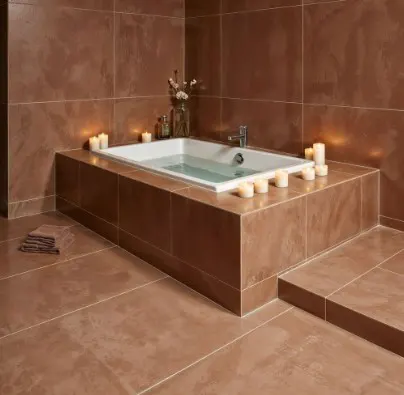
Vinyl vs. Tile: Which Is Better for a Bathroom?
Vinyl and tile solve the same basic problem in different ways.
Tile
Tile is particularly strong when the priorities are:
- Long-term durability
- Hard-wearing surfaces
- Premium appearance
- Radiant heating compatibility
- Extensive design options
Vinyl
Vinyl can be more attractive when the priorities are:
- Comfortable underfoot
- Easier routine maintenance
- Lower installation complexity
- Cost efficiency
- Faster renovation
- Wood or stone-look designs
Tile is not automatically the better choice simply because it is harder, and vinyl is not automatically better because it is softer.
The right choice depends on how the bathroom will be used and which performance characteristics matter most.
Is Sheet Vinyl Good for Bathrooms?
Yes. Quality sheet vinyl can be an excellent bathroom flooring option when the product is designed for the application and installed correctly.
Its biggest advantage is the ability to cover much of the floor with a continuous sheet, reducing the number of joints where water could potentially penetrate.
It also offers a softer surface than tile and can reproduce wood, stone, and other decorative patterns.
However, sheet vinyl is not a substitute for proper bathroom waterproofing. Areas around toilets, bathtubs, showers, drains, walls, and other penetrations still need appropriate installation and sealing details.
Recent flooring guides continue to identify sheet vinyl as a practical bathroom option, particularly where moisture resistance, comfort, and cost are priorities.
Is SPC Flooring Good for Bathrooms?
SPC can be a suitable bathroom flooring option when the specific product is designed and approved for bathroom use.
Its rigid stone-polymer composite core provides dimensional stability and does not rely on a wood-fiber core. Suitable products can therefore provide strong moisture resistance.
However, the word SPC alone does not determine whether a product is appropriate for every bathroom.
Before installation, check:
- Waterproof performance
- Installation method
- Joint construction
- Expansion requirements
- Subfloor requirements
- Slip resistance
- Manufacturer’s approved applications
This distinction is important because bathroom performance depends on the complete flooring system, not simply the name of the flooring category.
Waterproof Flooring Does Not Mean a Waterproof Bathroom
This is one of the most important points to understand.
A flooring product can be waterproof while the installed floor system is not completely waterproof.
For example, individual LVP or SPC planks may not be damaged by water, but water can still enter through:
- Joints
- Expansion gaps
- Perimeter edges
- Toilet openings
- Floor penetrations
- Poorly sealed transitions
This is why installation is particularly important in bathrooms. Current industry guidance also emphasizes that waterproof flooring material does not automatically make the entire floor assembly waterproof.
For areas exposed to substantial water, flooring should be considered together with the underlying waterproofing, drainage, substrate, and edge-detail system.
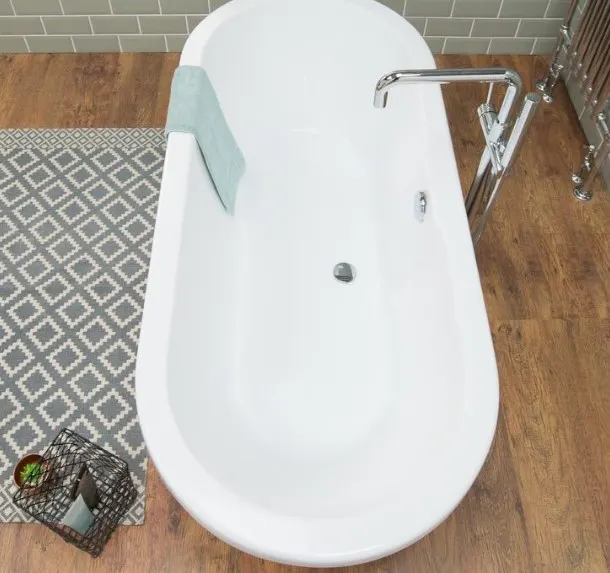
What Flooring Should You Avoid in a Bathroom?
Some flooring categories are generally less suitable for bathrooms because they are more vulnerable to prolonged moisture exposure.
Standard Laminate
Traditional laminate commonly uses a wood-fiber core. If water reaches the core through joints or damaged areas, swelling and structural damage can occur.
Even products marketed as “water-resistant” should be evaluated carefully for the specific bathroom application.
Solid Hardwood
Natural wood is sensitive to moisture and changes in humidity. Although some manufacturers offer wood products with enhanced moisture protection, solid hardwood generally requires more careful environmental control than vinyl or tile.
Carpet
Carpet can absorb moisture and is difficult to maintain in areas that experience frequent water exposure. It is generally not an appropriate choice for standard bathroom floors.
Best Waterproof Flooring by Bathroom Type
Different bathrooms have different requirements.
| Bathroom Type | Flooring Options to Consider |
|---|---|
| Powder Room | LVT/LVP, sheet vinyl, tile |
| Family Bathroom | Sheet vinyl, LVT/LVP, SPC, tile |
| Master Bathroom | LVT/LVP, SPC, tile, natural stone |
| Children’s Bathroom | Sheet vinyl, LVT/LVP, SPC |
| Rental Bathroom | Sheet vinyl, LVT/LVP |
| High-Moisture Bathroom | Sheet vinyl, suitable vinyl systems, tile |
| Premium Bathroom | Porcelain tile, natural stone, premium LVT |
For wet rooms or areas where water is expected to reach the floor extensively, the flooring should be selected as part of a complete wet-area system rather than as an isolated surface product.
How to Choose the Right Waterproof Flooring for a Bathroom
Instead of choosing flooring based on appearance alone, evaluate the following factors.
1. How Much Water Will the Floor Encounter?
A powder room has very different moisture exposure from a family bathroom with a bathtub or a dedicated wet room.
2. How Important Is Seam Reduction?
If minimizing potential water paths is a priority, sheet vinyl can have an advantage because it can cover large areas with few seams.
3. How Important Is Comfort?
Vinyl generally feels softer and warmer than porcelain or ceramic tile, which can be noticeable in bathrooms where people frequently walk barefoot.
4. How Much Maintenance Is Acceptable?
Consider not only daily cleaning but also grout maintenance, sealing, refinishing, and potential repairs.
5. What Installation System Is Required?
Check whether the product is:
- Glue-down
- Floating
- Loose-lay
- Fully adhered
- Sheet-installed
The installation method affects both performance and maintenance.
6. What Does the Manufacturer Specify?
Always check the product’s technical documentation for:
- Bathroom suitability
- Water resistance or waterproof performance
- Slip resistance
- Installation requirements
- Subfloor requirements
- Cleaning instructions
- Warranty conditions
FAQs
What is the best waterproof flooring for a bathroom?
Porcelain tile, sheet vinyl, LVT/LVP, and suitable SPC flooring can all be good choices. The best option depends on moisture exposure, slip resistance, comfort, installation requirements, maintenance, and budget.
What is the most waterproof bathroom flooring?
Sheet vinyl can provide excellent water management because it can be installed with very few seams. Porcelain tile and suitable waterproof vinyl products also offer strong moisture resistance when properly specified and installed.
Is sheet vinyl good for bathrooms?
Yes. Sheet vinyl is a practical bathroom flooring option because it is moisture-resistant, comfortable, easy to maintain, and can minimize seams across the floor.
Is LVP better than sheet vinyl for a bathroom?
Not necessarily. Sheet vinyl can have an advantage where minimizing seams and managing water are priorities, while LVP offers more plank-based design options and easier localized replacement.
Is SPC flooring good for bathrooms?
Suitable SPC flooring can perform well in bathrooms because its rigid core provides dimensional stability and waterproof constructions are available. Always verify the manufacturer’s bathroom-use and installation requirements.
Is tile better than vinyl for bathrooms?
Tile offers excellent durability and a premium appearance, while vinyl is generally softer, warmer, and easier to maintain. The better choice depends on the project’s priorities.
Is waterproof flooring completely waterproof after installation?
Not always. The flooring material may be waterproof, but water can still reach the subfloor through seams, edges, penetrations, or incorrect installation. Proper installation and bathroom waterproofing details remain essential.
What flooring should be avoided in a bathroom?
Standard laminate, solid hardwood, and carpet are generally less suitable for bathrooms because they are more vulnerable to moisture or difficult to maintain in wet conditions.
Can waterproof flooring be installed over tile?
Some flooring systems can be installed over existing tile if the substrate meets the manufacturer’s requirements for flatness, stability, cleanliness, and moisture conditions. The installation instructions for the specific product should always take priority.
Does waterproof bathroom flooring need to be sealed?
The answer depends on the flooring type and installation system. Tile installations may require attention to grout and perimeter joints, while sheet vinyl and vinyl plank systems have different edge and seam requirements. Follow the manufacturer’s installation specifications.
Conclusion
The best waterproof flooring for a bathroom is not determined by one material alone. Sheet vinyl, LVT/LVP, SPC, porcelain tile, and other suitable flooring systems each have different advantages.
For projects where minimizing seams, comfort, moisture resistance, and cost are priorities, sheet vinyl can be a particularly practical solution. For projects focused on rigid construction, plank or tile formats, or specific design requirements, suitable vinyl products or tile may be more appropriate.
The most reliable approach is to evaluate the flooring material, installation system, moisture exposure, slip resistance, and subfloor together before making a final selection.
Looking for waterproof flooring for your bathroom project? Contact timmy.wu@timotechs.com to discuss your requirements and explore suitable sheet vinyl, SPC, and other flooring solutions from TIMOTECH.