Herringbone wood flooring is a decorative flooring pattern made by arranging rectangular wood planks in a repeating zigzag layout. Unlike straight-laid flooring, herringbone creates a stronger sense of movement and visual depth, making the floor an important part of the overall interior design. It is available in different wood species, plank sizes, finishes, and constructions, including solid and engineered wood. However, its distinctive appearance also comes with more demanding installation and planning requirements.
What Is Herringbone Wood Flooring?
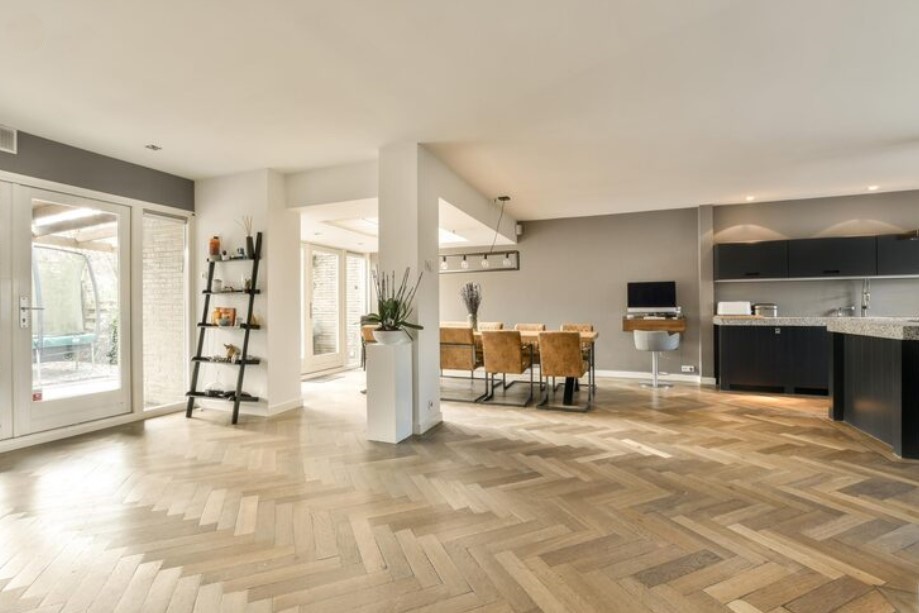
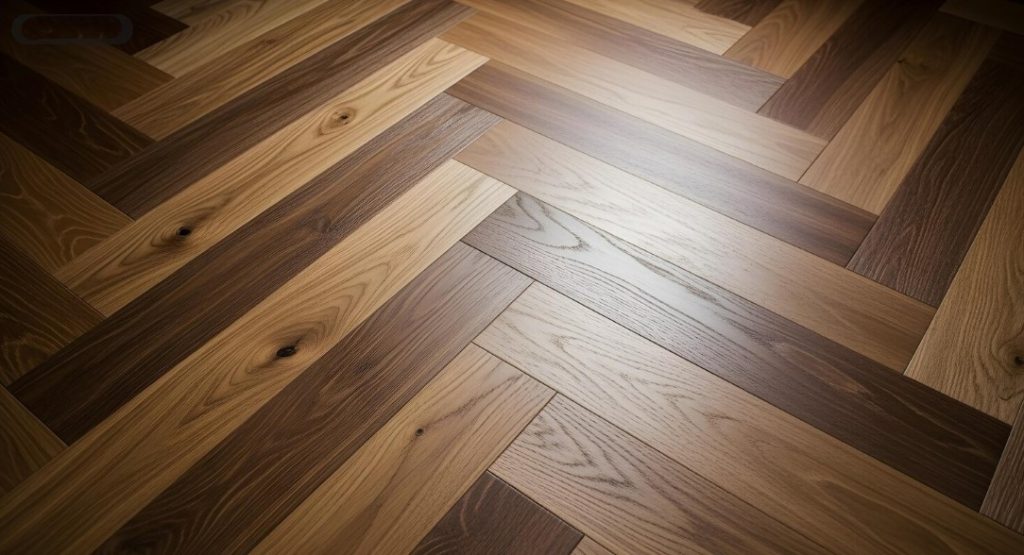
Herringbone wood flooring consists of rectangular planks arranged so that each plank meets the next at a right angle, creating a broken zigzag pattern.
The pattern is part of the broader category of parquet flooring, which refers to wood flooring arranged in deliberate geometric patterns rather than conventional parallel rows.
The key characteristic of herringbone is its square-cut rectangular boards and 90-degree arrangement. This distinguishes it from chevron flooring, where angled plank ends meet to form a continuous V-shaped pattern.
Although herringbone has a long history in traditional interiors, modern flooring manufacturers offer the pattern in a wide range of wood species, finishes, dimensions, and engineered constructions. Herringbone can also be produced in materials other than natural wood, including luxury vinyl and laminate, so the pattern itself should not be confused with a specific flooring material.
Herringbone vs. Chevron: What Is the Difference?
Herringbone and chevron are often confused because both create a zigzag appearance, but their plank geometry is different.
| Feature | Herringbone | Chevron |
|---|---|---|
| Plank shape | Rectangular | Angled ends |
| Board ends | Square-cut | Mitred, commonly at an angle |
| Pattern | Broken zigzag | Continuous V |
| Installation | Precise | More angle-sensitive |
| Visual effect | Textured and traditional | Directional and geometric |
| Typical complexity | Higher than straight lay | Generally higher than herringbone |
With herringbone, rectangular boards meet at 90-degree angles, producing a series of broken zigzags. Chevron planks are cut at an angle so they meet point-to-point, creating continuous V-shaped lines.
This difference also affects manufacturing and installation. Chevron requires greater precision because the angled ends need to align consistently across the floor, while herringbone uses simpler rectangular pieces.
If you want a classic, textured pattern, herringbone is often the more versatile choice. If you prefer a sharper, continuous geometric effect, chevron may be more suitable.
Types of Herringbone Wood Flooring
Herringbone is not limited to one visual style. The size and proportions of the individual planks can significantly change the appearance of the finished floor.
Traditional Herringbone
Traditional herringbone uses relatively compact rectangular blocks to create a clearly defined zigzag pattern. It works particularly well in classic, transitional, and heritage-inspired interiors.
Narrow Herringbone
Narrower planks create a finer, more detailed pattern. This can be useful when you want the herringbone layout to remain visually refined rather than becoming the dominant feature of the room.
Long Herringbone
Longer planks produce a more elongated pattern with fewer visual breaks. This approach is often used in larger rooms and contemporary interiors where a stronger sense of scale is desired.
Double Herringbone
Double herringbone uses pairs of planks to create a larger and more pronounced geometric pattern. Because the pattern is visually stronger, it generally works best when the flooring has enough surrounding space to remain balanced.
The terminology used for different herringbone formats varies between manufacturers, so plank dimensions should always be checked rather than relying on the product name alone.
What Wood Is Best for Herringbone Flooring?
There is no single wood species that is best for every herringbone installation. The choice should consider durability, grain appearance, color, finish, availability, and the overall design of the space.
Oak Herringbone Flooring
Oak is one of the most common choices for herringbone flooring because it combines a versatile appearance with good durability and works well with a wide range of stains and finishes.
Its natural grain can also reinforce the geometry of the herringbone pattern without overwhelming it.
Walnut Herringbone Flooring
Walnut provides deeper brown tones and a more dramatic appearance. It can make the geometric pattern particularly prominent, making it suitable for interiors where the floor is intended to become a design feature.
Ash Herringbone Flooring
Ash generally provides lighter tones with visible grain variation. It can create a brighter and more contemporary appearance.
Maple Herringbone Flooring
Maple offers relatively light coloring and a more restrained grain pattern. It can work well when you want the herringbone geometry to be visible without strong color variation.
Ultimately, the best wood species depends on the desired appearance and the performance requirements of the project.
Solid vs. Engineered Herringbone Wood Flooring
Another important decision is whether to choose solid or engineered wood.
Solid Wood Herringbone
Solid wood is made from a single piece of natural timber.
Potential advantages include:
- Authentic natural wood construction
- Long service life with appropriate care
- Ability to be sanded and refinished multiple times, depending on the installation and remaining material
However, solid wood is more sensitive to changes in moisture and environmental conditions than engineered construction. Appropriate acclimation, subfloor preparation, and environmental control are particularly important for patterned installations.
Engineered Herringbone
Engineered wood combines a real wood surface layer with a multi-layer structural core.
Its cross-layer construction can provide greater dimensional stability than solid wood in many applications, which is one reason engineered wood is widely used for patterned flooring and installations over concrete subfloors or radiant heating systems when the specific product is approved for those applications.
However, not all engineered flooring is constructed to the same specification. The thickness of the real wood wear layer, core construction, finish, installation system, and manufacturer’s requirements should all be checked.
Solid and engineered herringbone flooring can both be excellent choices. The better option depends on the building conditions, subfloor, installation method, and long-term expectations.
What Are the Advantages of Herringbone Wood Flooring?
Timeless Appearance
Herringbone has remained popular because its geometric structure can work with both traditional and contemporary interiors.
It can complement:
- Classic interiors
- Modern homes
- Boutique hospitality spaces
- Offices
- Luxury residential projects
- Heritage-inspired designs
Strong Visual Character
Unlike straight-laid planks, herringbone creates movement across the floor. This allows the flooring itself to become part of the interior design rather than simply serving as a neutral surface.
Versatile Design Options
Herringbone can be customized through:
- Wood species
- Plank dimensions
- Color
- Stain
- Surface finish
- Pattern scale
- Installation direction
This makes it possible to create very different looks using the same basic pattern.
Works Across Different Room Styles
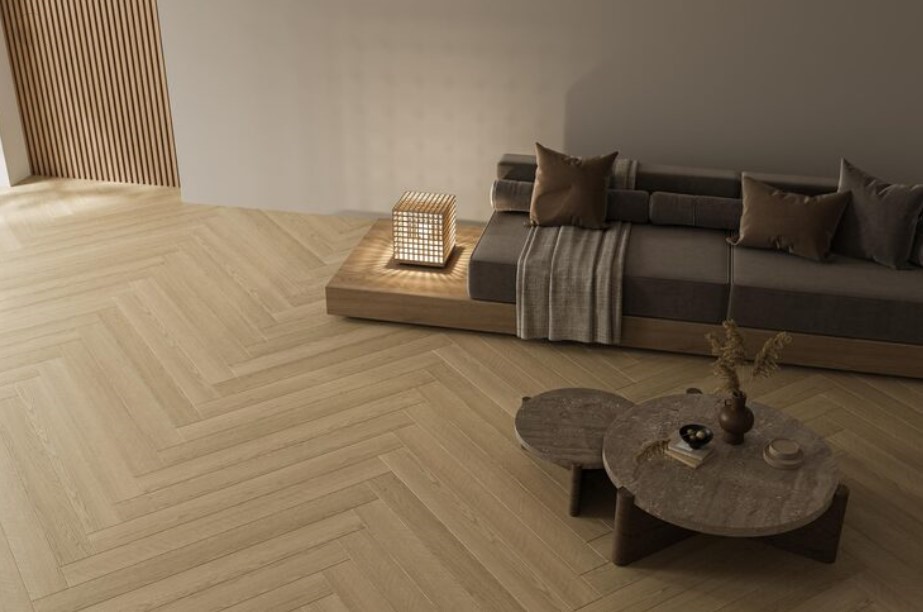
Herringbone does not have to be associated with a traditional interior. The same pattern can appear modern when combined with wider planks, lighter finishes, minimal furniture, and contemporary architectural details.
Natural Wood Can Be Refinished
When properly constructed and maintained, solid wood and some engineered wood floors can be refinished. The number of possible refinishing cycles depends on the construction and thickness of the usable wood layer.
What Are the Disadvantages of Herringbone Wood Flooring?
More Complex Installation
Herringbone requires accurate planning and consistent alignment. The installer must establish the correct starting point and maintain the pattern throughout the room.
It is considerably less forgiving than a simple straight-laid floor if the layout begins incorrectly.
Higher Installation Cost
Patterned flooring generally requires more labor than straight-laid flooring because of the additional layout, cutting, fitting, and alignment involved. Current industry guides consistently identify installation complexity as one of the main reasons patterned flooring costs more to install.
However, there is no universal percentage or fixed cost premium. Labor rates, room geometry, installation method, product format, and local market conditions can all affect the final price.
More Cutting and Material Waste
Herringbone creates more perimeter cuts than a conventional parallel plank installation.
The amount of additional material required depends on the room shape, pattern dimensions, starting layout, and installer. It is therefore better to ask for a project-specific waste allowance rather than applying one universal percentage.
Requires a Well-Prepared Subfloor
Patterned floors are less forgiving of uneven substrates because small variations can become more noticeable as the pattern progresses across the room.
Subfloor flatness, moisture conditions, cleanliness, and structural suitability should be checked before installation.
The Pattern May Not Suit Every Interior
Herringbone adds visual movement. In a room that already contains strong patterns, highly figured furniture, decorative walls, or busy finishes, a large-scale herringbone floor may make the overall design feel too visually complex.
The solution is not necessarily to avoid herringbone, but to choose the appropriate plank size, color, and finish.
Is Herringbone Flooring More Expensive?
Herringbone flooring can cost more to install than straight-laid flooring, but the reason is not simply that the pattern itself is more expensive.
The main cost factors include:
- More complicated layout
- Additional cutting
- More time spent maintaining alignment
- Greater installation skill
- Potentially higher material waste
- Product format and construction
- Room shape and size
Chevron generally requires even greater precision because of its angled plank ends.
For this reason, when comparing quotes, separate the flooring material cost from the installation cost. A higher total price does not necessarily mean the material itself is significantly more expensive.
Is Herringbone Flooring Suitable for Small Rooms?
Yes, herringbone can work well in small rooms, but the scale of the pattern matters.
A small room does not automatically require straight-laid flooring. Instead, consider:
Smaller Planks
A finer herringbone pattern can maintain visual detail without overwhelming the room.
Lighter Colors
Lighter wood tones can create a more open and airy appearance.
Lower Contrast
Strongly contrasting planks can make the pattern much more prominent. A more consistent color palette can create a quieter appearance.
Pattern Direction
The direction in which the herringbone runs can influence how the room is perceived. The layout should be considered alongside the room’s proportions, entrances, windows, and major sightlines.
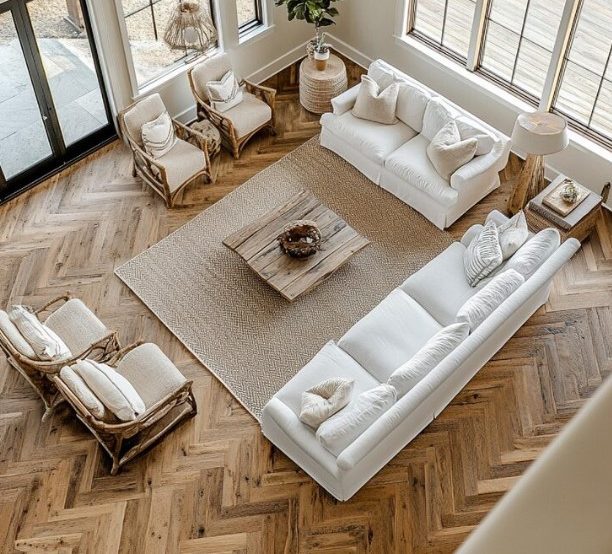
In larger rooms, longer or wider herringbone formats can create a stronger architectural statement.
How to Choose the Right Herringbone Plank Size
Plank dimensions are one of the most overlooked aspects of herringbone flooring.
A narrow, short plank creates a much denser pattern than a long, wide plank.
| Pattern Scale | Typical Visual Effect |
| Narrow and short | Detailed, traditional |
| Medium | Balanced and versatile |
| Long and narrow | More elongated and contemporary |
| Wide and long | Bold, spacious, architectural |
The right size depends on the dimensions of the room and the desired visual effect.
For a small room, an extremely large pattern can dominate the space. For a large open-plan area, very small pieces may make the floor appear overly busy.
It is therefore useful to view a full-size sample or larger installed area rather than judging the pattern from a single small plank.
How Is Herringbone Wood Flooring Installed?
Herringbone installation requires more planning than a straight-laid floor.
A typical installation process involves:
- Inspecting and preparing the subfloor
- Checking moisture and flatness where required
- Planning the pattern and room layout
- Establishing accurate reference lines
- Determining the starting point
- Installing the first herringbone sections
- Maintaining consistent alignment
- Cutting pieces around walls and obstacles
- Completing the perimeter
- Installing transitions and finishing details
The first section is particularly important because an error at the starting point can become increasingly visible as the pattern continues across the room.
For this reason, herringbone is generally better suited to an experienced flooring installer than a basic DIY installation.
Herringbone Wood Flooring vs. Herringbone LVP
Herringbone is a pattern rather than a material, so the same visual arrangement can be produced using different flooring materials.
Natural wood provides:
- Authentic wood grain
- Natural variation
- A traditional material character
- Refinishing potential for suitable products
Herringbone LVP or SPC can provide:
- Wood-look designs
- Different moisture-resistance characteristics
- Easier routine maintenance in many applications
- Different installation systems
- A broader range of application-specific constructions
The better choice depends on what matters most for the project.
If authentic natural wood is the primary priority, engineered or solid wood may be appropriate. If moisture resistance, simplified maintenance, or a specific performance requirement is more important, a herringbone vinyl product may be worth considering.
The key is to evaluate the material and the pattern separately. Choosing herringbone does not determine whether the flooring is wood, vinyl, laminate, or another material.
How to Maintain Herringbone Wood Flooring
Herringbone flooring does not necessarily require a completely different maintenance routine from other wood flooring, but its joints and detailed pattern make consistent care important.
Recommended practices include:
- Vacuum or sweep regularly to remove grit
- Clean according to the flooring manufacturer’s instructions
- Avoid excessive water
- Use suitable cleaning products
- Place protective pads under furniture
- Use entrance mats in high-traffic areas
- Address spills promptly
- Maintain suitable indoor environmental conditions
For finished wood floors, the appropriate maintenance method depends on the finish, such as oil, lacquer, or another surface treatment.
Always follow the flooring manufacturer’s care instructions rather than applying a universal cleaning method to every wood floor.
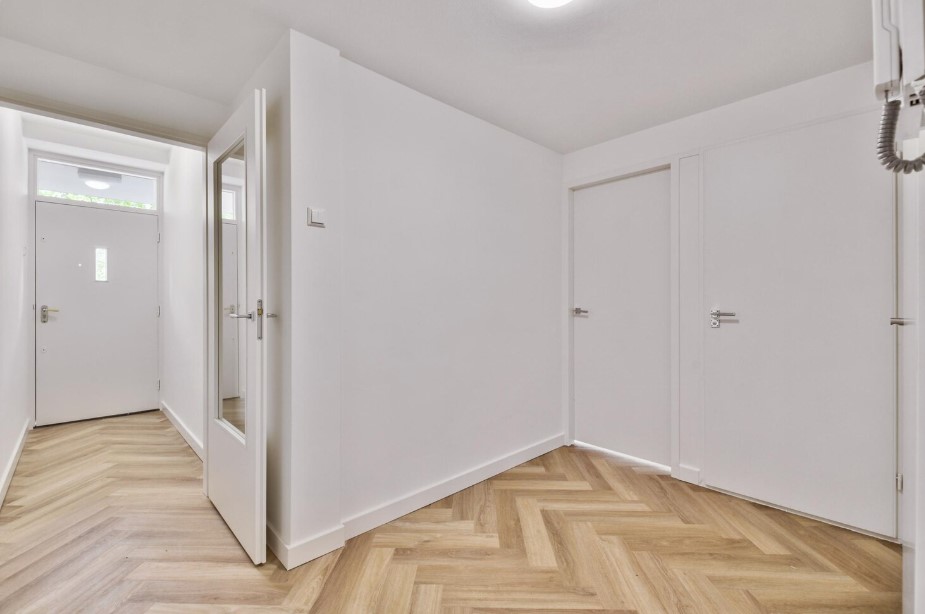
Is Herringbone Wood Flooring Right for Your Project?
Herringbone is worth considering when you want the flooring to contribute strongly to the overall design.
It may be a good choice if you prioritize:
- A distinctive geometric appearance
- A timeless flooring pattern
- Natural wood character
- Design flexibility
- A floor that works as an architectural feature
A different flooring format may be more appropriate if your priorities are:
- The simplest installation
- The lowest installation labor
- Minimal visual pattern
- Maximum installation speed
- Specific moisture or maintenance requirements
The best flooring choice is ultimately determined by the combination of appearance, material, room conditions, installation requirements, and budget.
FAQs
What is herringbone wood flooring?
Herringbone wood flooring is a parquet pattern made from rectangular wood planks arranged at right angles to create a repeating broken zigzag. The pattern can be produced using solid or engineered wood and is also available in non-wood flooring materials.
Is herringbone flooring more expensive than straight flooring?
Herringbone flooring can cost more because it requires more layout planning, cutting, fitting, and installation labor than a straight-laid floor. The actual cost difference depends on the product, room layout, installer, and local labor rates.
Is herringbone flooring difficult to install?
Yes. Herringbone requires precise layout, alignment, cutting, and subfloor preparation. Professional installation is generally recommended, particularly for larger or more complex projects.
What is the difference between herringbone and chevron flooring?
Herringbone uses rectangular, square-ended planks arranged at right angles to create a broken zigzag. Chevron uses angled plank ends that meet point-to-point to create a continuous V-shaped pattern.
Is herringbone flooring suitable for small rooms?
Yes. Herringbone can work in small rooms when the plank size, color, and pattern scale are appropriate. Smaller-scale patterns and lighter, lower-contrast finishes can help maintain visual balance.
What wood is best for herringbone flooring?
Oak is a popular choice because of its durability, versatile grain, and compatibility with many finishes. Walnut, ash, maple, and other species can also be suitable depending on the desired appearance and performance requirements.
Is solid or engineered wood better for herringbone?
Neither is universally better. Engineered wood can provide greater dimensional stability in many applications, while solid wood offers a traditional all-wood construction and can generally be refinished multiple times. The right choice depends on the subfloor, environment, installation method, and product specification.
Does herringbone flooring make a room look bigger?
Herringbone can influence how a room is perceived by creating directional movement, but it does not automatically make every room look larger. Plank size, color, layout direction, lighting, and room proportions all affect the result.
Can herringbone flooring be installed over underfloor heating?
Some engineered herringbone flooring products can be installed over compatible underfloor heating systems, but suitability depends on the specific product construction and manufacturer’s requirements. Always verify compatibility before installation.
How long does herringbone wood flooring last?
A well-made wood floor can have a long service life when properly installed and maintained. The actual lifespan depends on the wood construction, finish, traffic, maintenance, environmental conditions, and whether the floor can be refinished.
Conclusion
Herringbone wood flooring combines the natural character of wood with a distinctive geometric pattern. Its main advantages are visual impact, design versatility, and timeless appeal, while its main considerations are installation complexity, cost, material waste, and the need for a well-prepared subfloor.
Before choosing a herringbone floor, consider not only the pattern but also the wood species, construction, plank dimensions, room size, installation method, and long-term maintenance requirements. The right combination will determine whether herringbone delivers the appearance and performance you expect from the project.
Looking for the right herringbone flooring for your project? Contact timmy.wu@timotechs.com to discuss your requirements and explore suitable flooring solutions from TIMOTECH.