WPC wall panels are composite wall cladding materials made from a combination of wood fibers and thermoplastic polymers. They are designed to provide a stable, durable, and moisture-resistant alternative to traditional wall finishes such as natural wood panels, MDF boards, and PVC decorative sheets.
Unlike traditional finishing materials that rely on a single material property, WPC panels combine two behaviors:
- The rigidity and texture of wood fibers
- The stability and water resistance of plastic polymers
This combination makes WPC suitable for interior and semi-outdoor wall systems where both appearance and long-term performance matter.
Why WPC Is Not Just a Decorative Material
Although used for wall decoration, WPC behaves differently from typical decorative boards.
It requires:
- Installation tolerance design
- Environmental adaptation before installation
- Proper joint spacing control
This makes it closer to a semi-engineered wall system, not just a surface material.
WPC Wall Panel Structural Types
In real construction and interior projects, WPC wall panels are not selected only by appearance. The internal structure design determines how they perform in different environments such as residential walls, commercial spaces, and high-traffic architectural interiors.
Although all WPC panels share the same material base, the structural profile design leads to very different performance behavior in terms of rigidity, visual depth, and installation efficiency.
Below are the three most widely used structural types.
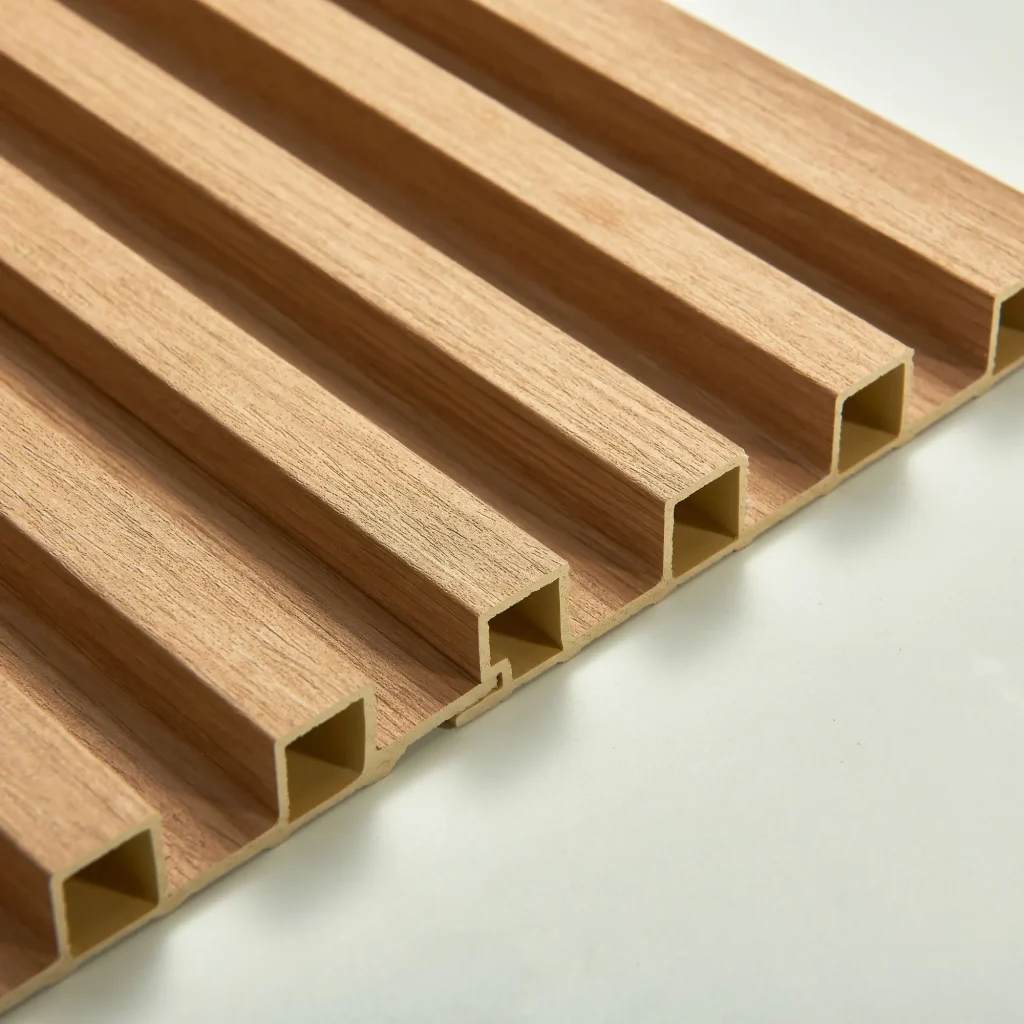
1. Grille Wall Panels
Grille wall panels are designed with a linear slat structure that creates repeated spacing between strips. This design is widely used in modern architecture because it combines decoration with spatial layering.
How the structure affects performance
The open-gap geometry changes how light and shadow interact with the wall surface. Instead of a flat visual plane, the wall becomes a layered surface with depth perception.
From a functional perspective:
- The structure reduces visual heaviness on large walls
- It helps break continuous wall monotony in commercial interiors
- It allows partial air circulation between slats in semi-open spaces
Where it performs best
Grille panels are commonly used in:
- Office reception areas
- Hotel corridors and lobbies
- Exhibition booths and display walls
- Feature walls behind branding elements
Selection logic
Grille panels are preferred when the project requires:
- A modern architectural look
- Strong visual rhythm in interior design
- Wall systems that do not feel “flat or heavy”
2. Great Wall Panels
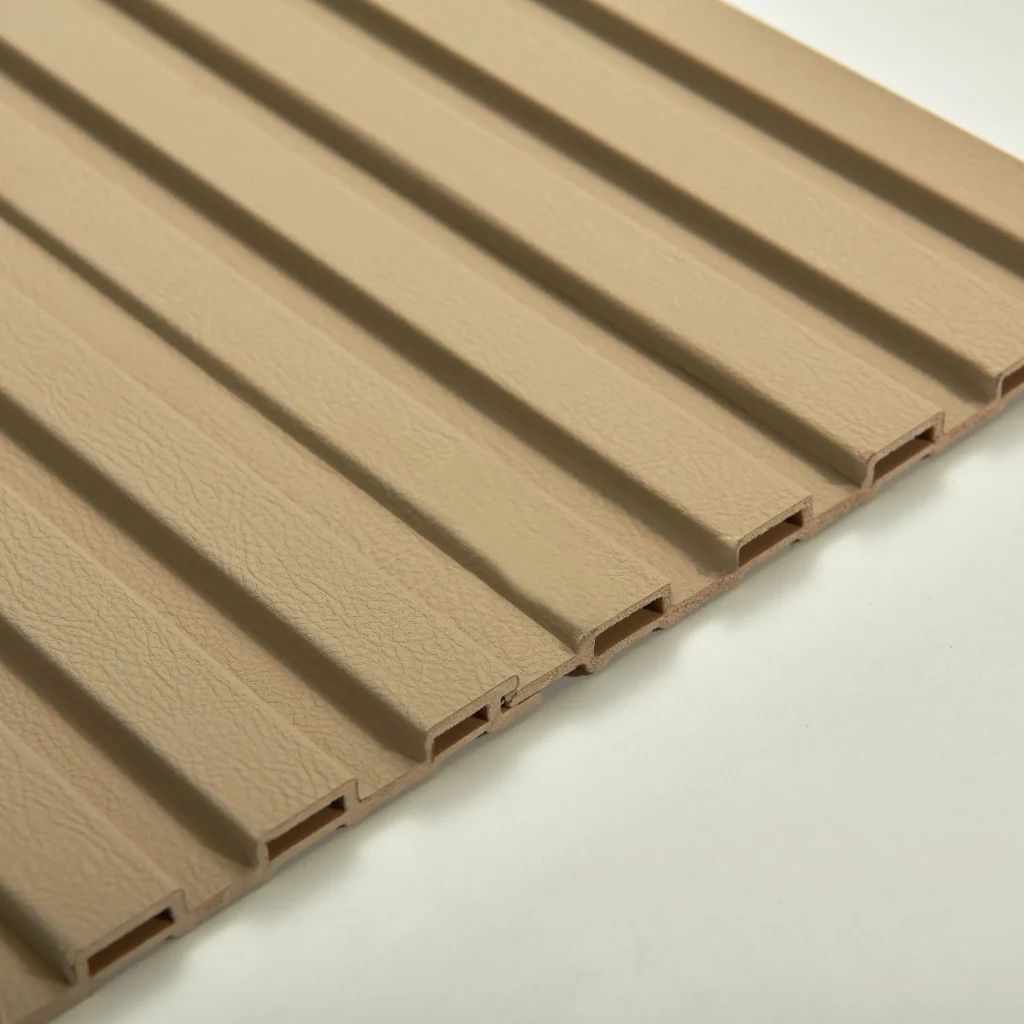
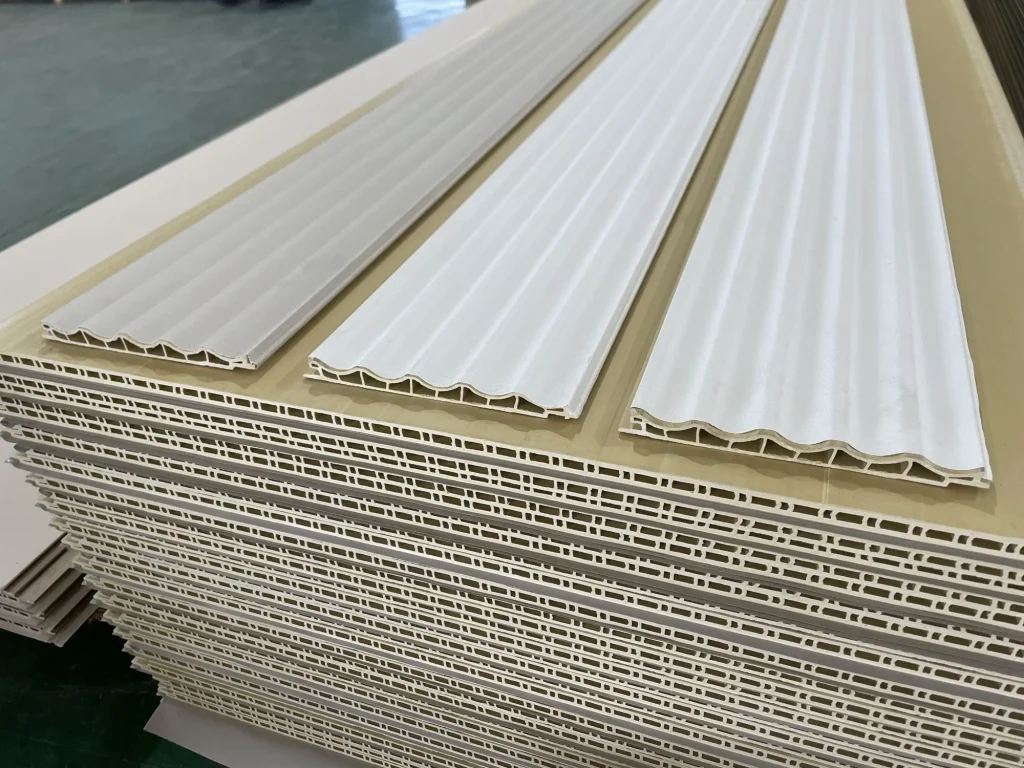
Great wall panels are one of the most commonly used WPC wall panels in residential and commercial interiors. Their surface profile resembles a continuous wave or stepped structure, which creates strong shadow variation under lighting.
Why this structure matters
The wave geometry is not just decorative. It increases surface stiffness by introducing repeated structural ridges. This reduces the chance of surface deformation over time, especially in medium-impact environments.
Compared with flat panels:
- The profile distributes stress more evenly
- It reduces visible scratches due to broken light reflection
- It improves structural rigidity without increasing thickness
Practical advantages
Great Wall panels are often selected because they:
- Are easier to install compared to complex profiles
- Offer strong visual impact at relatively low cost
- Perform well in both residential and light commercial spaces
Typical applications
- Living room TV background walls
- Bedroom decorative walls
- Retail store interiors
- Café and restaurant wall systems
Selection logic
This type is suitable when:
- Budget efficiency is important
- Fast installation is required
- Decorative effect is still a priority
In real procurement projects, this type often becomes the “default choice” because it balances cost and visual performance effectively.
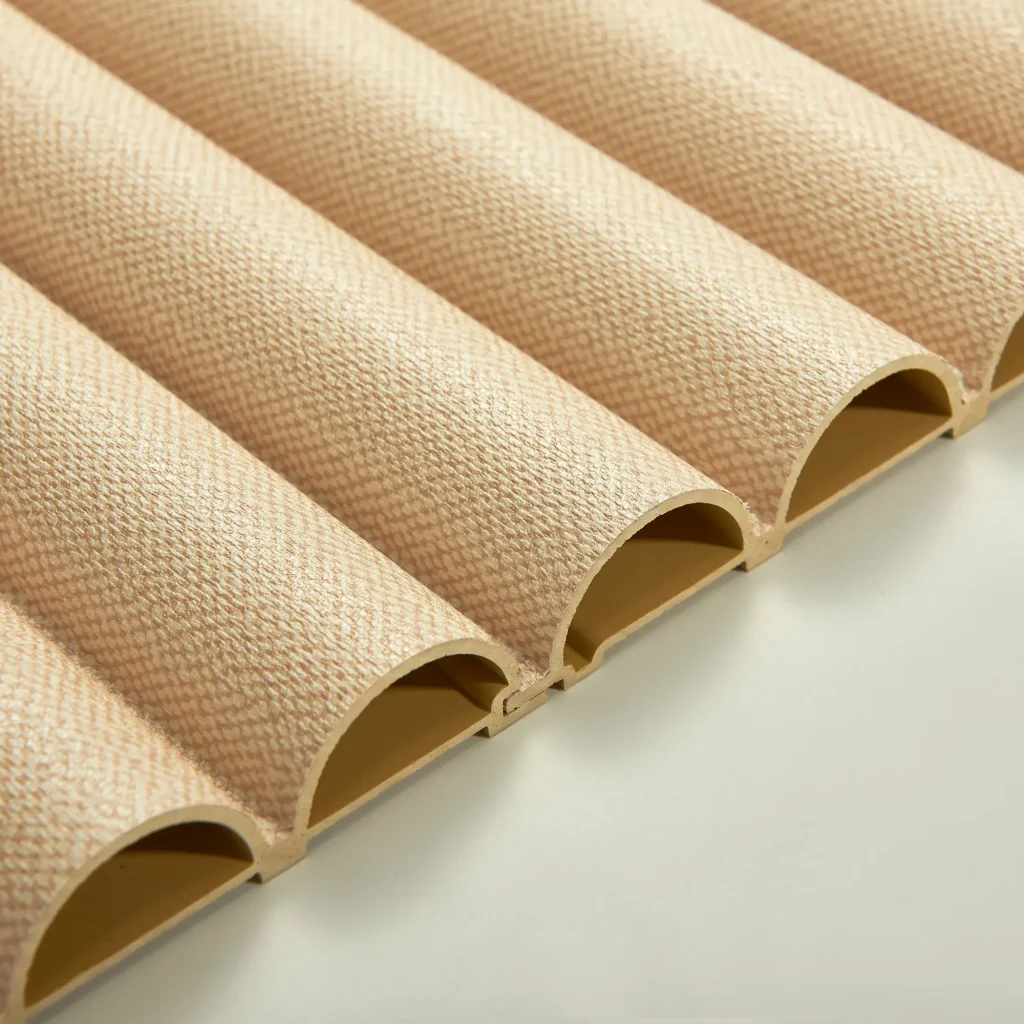
3. Half Round / Inner Round Wall Panels
Half Round and Inner Round panels introduce curved geometry into the wall system. Unlike linear or wave structures, these panels are designed for soft visual transitions.
Structural challenge and production impact
Curved WPC profiles are more difficult to manufacture because:
- The extrusion process requires tighter control of cooling rate
- Uneven internal stress can occur during forming
- Dimensional consistency is harder to maintain across long batches
Because of this, production quality control becomes more critical than in standard profiles.
Visual and spatial effect
The curved surface creates:
- Softer light reflection compared to sharp-edged profiles
- A more premium and architectural visual tone
- Reduced visual harshness in interior environments
Where it is used
- High-end residential interiors
- Boutique hotel design projects
- Luxury retail environments
- Exhibition feature installations
Selection logic
This type is selected when:
- The design concept focuses on premium aesthetics
- The project requires a soft architectural language
- Visual branding is a key factor in interior space design
Technical Specifications of WPC Wall Panels
Selecting WPC wall panels correctly requires understanding technical parameters rather than only design appearance. These specifications directly influence installation behavior, durability, and long-term performance.
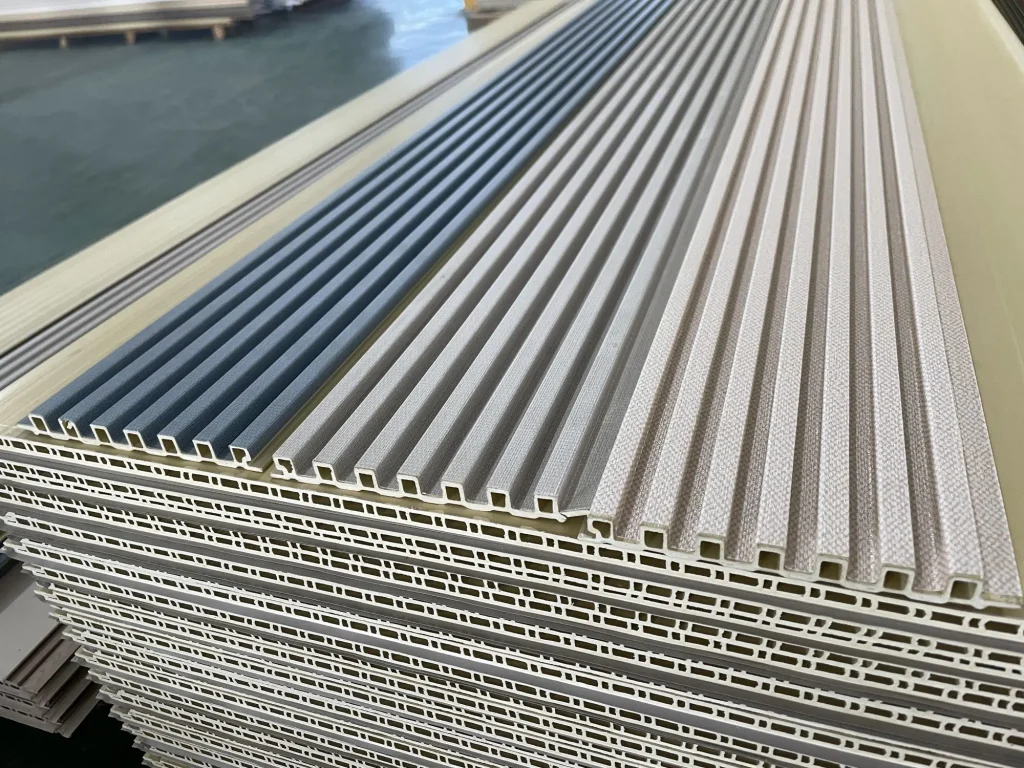
Thickness Range
Common industry thickness options include:
- 9mm
- 12mm
- 15mm
- 18mm
How thickness affects performance
- Thin panels (9–12mm)
→ Easier installation, lighter weight, suitable for ceilings or low-impact walls - Medium panels (12–15mm)
→ Balanced strength and flexibility, widely used in residential applications - Thick panels (15–18mm)
→ Higher rigidity and impact resistance, suitable for commercial or high-traffic areas
Thicker panels also reduce visible wall irregularities because they provide better surface leveling tolerance.
Density Range
Typical density range:
- 0.6 – 1.2 g/cm³
Why density matters in real projects
Density determines how the panel behaves after installation:
- Lower density
→ Easier cutting and installation, but lower impact resistance - Higher density
→ Better structural stability, improved long-term durability
In long-term wall systems, density also influences creep behavior (slow deformation under continuous stress), which becomes important in large commercial wall installations.
Surface Finish Types
Surface treatment affects both aesthetics and durability:
Common surface options:
- Wood grain embossing
- UV coating layer
- Laminated decorative film
Functional impact:
- Embossed surfaces improve natural wood realism
- UV coating reduces fading in sun-exposed areas
- Laminated films improve color consistency across batches
Surface finish is often the first visible quality indicator for clients, especially in hotel or retail projects.
Installation System Types
Installation design plays a major role in project efficiency.
Common systems:
- Tongue and groove locking system
- Clip fixing system
- Adhesive-assisted installation (rare cases)
Engineering impact:
- Locking systems improve alignment accuracy
- Clip systems increase installation speed
- Adhesive systems are used only for specific flat substrates
Proper installation design reduces long-term maintenance issues such as joint separation or misalignment.
Performance Characteristics of WPC Wall Panels
The performance of WPC wall panels is not defined by appearance, but by how the material reacts under long-term environmental conditions such as temperature changes, humidity exposure, UV radiation, and installation stress.
Understanding these behaviors is essential for avoiding common installation problems such as warping, joint separation, or surface deformation.
Water Resistance Mechanism
One of the main reasons WPC wall panels are widely used in modern construction is their improved moisture resistance compared to natural wood-based materials.
Unlike solid wood, WPC does not rely on open capillary channels. Instead, the polymer matrix surrounds wood fibers, reducing direct water penetration paths.
What actually happens in humid environments:
- Water does not easily enter the internal structure
- Surface remains stable under normal indoor humidity
- Edge areas are slightly more sensitive if sealing is poor
Practical implication in projects:
- Suitable for kitchens, bathrooms, and coastal buildings
- Reduces risk of swelling compared to MDF or plywood
- Still requires proper edge protection in long-term humid exposure
In real applications, high-quality systems (such as controlled-density wall panels from manufacturers like TIANAN) focus on reducing internal porosity to improve long-term moisture stability.
Thermal Expansion Behavior
Thermal expansion is one of the most important but often underestimated properties of WPC wall panels.
Because WPC contains thermoplastic components, it expands when heated and contracts when cooled.
What affects expansion rate:
- Panel length (longer panels expand more)
- Installation environment temperature
- Direct sunlight exposure
- Density of material
What happens if not controlled:
- Wall bulging
- Joint pressure buildup
- Locking system failure
- Visible uneven surface lines
Practical installation requirement:
- Expansion gap of 8–10mm must be maintained
- Large wall areas require segmented installation zones
- Avoid rigid fixing at all edges
This is why installation design is not optional—it directly determines system lifespan.
UV Resistance and Color Stability
In indoor and semi-outdoor applications, UV exposure affects long-term appearance more than structural performance.
What UV exposure causes:
- Gradual surface fading
- Slight color tone changes
- Surface aging in low-quality coatings
How WPC panels resist UV:
- UV stabilizers slow down polymer degradation
- Surface coatings act as protective layers
- Laminated finishes improve color retention
Application logic:
- Indoor use → standard UV protection sufficient
- Semi-outdoor use → reinforced UV-coated panels required
High-quality production systems maintain color consistency across batches, which is especially important in large commercial projects where wall panels must match across different zones.
Fire Performance
Fire behavior depends on the polymer system used in WPC wall panels.
WPC is not inherently non-combustible, but its fire resistance can be improved through formulation.
Key factors affecting fire behavior:
- PVC-based systems → better flame resistance
- PE-based systems → more flammable but flexible
- Additives → flame retardant performance varies
Procurement consideration:
For commercial projects such as:
- Hotels
- Shopping malls
- Office buildings
Fire rating requirements must be confirmed before material selection.
Cost Factors of WPC Wall Panels
Pricing of WPC wall panels is influenced by multiple technical and production factors, not just material size.
Main cost drivers:
1. Material density
Higher density = more raw material usage = higher cost
2. Surface finish type
- Simple embossing → lower cost
- UV + lamination → higher cost
3. Thickness
Thicker panels require more material and stronger extrusion control
4. Order volume
Bulk orders reduce unit production cost
5. Installation complexity
Complex profiles (such as curved panels) increase installation cost
Procurement insight
In real projects, selecting the cheapest option often leads to:
- Higher maintenance cost later
- Faster surface aging
- Higher replacement frequency
In large-scale projects, consistency across production batches becomes critical, as even small variations can affect the final visual result and installation alignment. Manufacturers with integrated production systems, such as TIANAN, typically focus on maintaining this level of consistency across different project phases.
That’s why choosing the right WPC wall panel supplier matters a lot.
We’ve explained this in more detail in our guide on how to choose a reliable WPC wall panel supplier in China.
Conclusion
WPC wall panels have become widely used in modern construction because they solve key limitations of traditional wall materials.
They offer:
- Better moisture resistance than wood-based panels
- More stable performance than MDF
- More natural appearance than PVC systems
- Lower lifecycle maintenance cost
From a project perspective, their real value is not only in appearance, but in long-term performance stability across different environments.
If you are planning a project and need reliable WPC wall panel solutions, feel free to reach out to timmy.wu@timotechs.com for product details and professional support.