The best flooring for a laundry room needs to handle moisture, heavy appliances, everyday wear, and frequent cleaning. Sheet vinyl, SPC or other rigid-core vinyl, and porcelain or ceramic tile are among the most practical options, but they solve the room’s demands in different ways.
A laundry room is not simply another interior space. A washing machine can leak, a drain can overflow, and detergent can spill onto the floor. The flooring also needs to support heavy equipment and remain practical to clean.
The right choice therefore depends on more than appearance. Water exposure, seams, appliance load, maintenance, installation, comfort, and the connection with adjacent rooms all deserve consideration.
What Should Laundry Room Flooring Be Able to Handle?
Laundry rooms have a different combination of demands from bedrooms or living rooms. Before comparing flooring materials, it helps to understand what the floor actually needs to withstand.
Water and Leaks
Water is the most obvious concern.
A washing machine has multiple potential water connections, and a laundry room may also contain a utility sink, floor drain, or other plumbing. Even a small leak can leave water on the floor for some time before it is noticed.
For this reason, flooring with verified waterproof performance is generally a more suitable choice than materials that are only designed to handle occasional spills.
However, there is an important distinction between waterproof flooring material and a waterproof floor assembly. A waterproof vinyl plank, for example, may resist water damage at the product level, but water can still move through plank joints, perimeter gaps, transitions, or other openings if the installation is not appropriate for the situation.
Heavy Appliances and Vibration
A washer and dryer remain in roughly the same location for years, and a washing machine can generate significant movement during high-speed spin cycles.
The flooring therefore needs adequate structural support and dimensional stability for the selected installation system. The condition of the subfloor matters just as much as the surface material.
Rigid-core vinyl is often considered for demanding residential areas because its stronger core provides greater resistance to dents and impacts than more flexible vinyl constructions.
Detergents and Stains
Laundry rooms are exposed to more than plain water.
Detergent, fabric softener, bleach, stain removers, and other household products may come into contact with the floor. A practical laundry room floor should therefore be easy to wipe and maintain without requiring complicated treatment.
Cleaning and Maintenance
Lint, dust, water spots, detergent residue, and dirt can accumulate around appliances.
A floor with a simple cleaning routine is usually easier to live with than one that requires frequent sealing or specialized maintenance.
Wet-Floor Safety
A laundry room floor can occasionally become wet, particularly around a washing machine or utility sink.
Slip resistance should therefore be considered alongside waterproof performance. The appropriate level depends on the specific product, surface finish, and installation environment rather than the flooring category alone.
Comfort and Appearance
Performance is important, but laundry rooms are increasingly designed as part of the home rather than treated as purely hidden utility spaces.
If the laundry room connects directly with a kitchen, mudroom, hallway, or living area, flooring appearance can also influence how cohesive the overall interior feels.
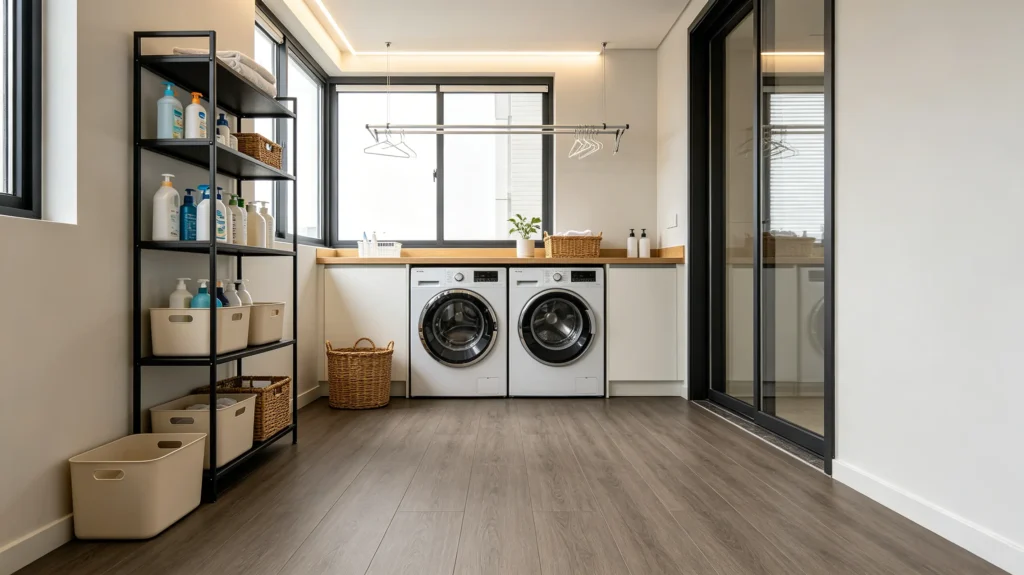
Best Flooring Options for a Laundry Room
Several flooring materials can work in a laundry room, but their strengths and limitations are different.
1. Sheet Vinyl
Sheet vinyl is one of the most practical flooring formats for a laundry room, particularly when minimizing seams is an important consideration.
Unlike plank or tile products, sheet vinyl can cover a large area with relatively few seams. That can reduce the number of joints through which water could potentially reach the substrate when the flooring is correctly installed.
Sheet vinyl is also available in wood, stone, tile, and other decorative appearances, so choosing it does not necessarily mean accepting a purely utilitarian look. Its large-sheet format and fewer seams as important reasons for its use in moisture-prone rooms such as laundry rooms.
Advantages:
- Large-format surface with fewer seams
- Good choice for moisture-prone spaces when the product is specified appropriately
- Easy to clean
- Comfortable compared with hard tile
- Available in a wide range of colors and patterns
- Suitable for both residential and commercial applications
Limitations:
- Installation requires careful measurement and fitting
- Seams, edges, and perimeter details still need proper treatment
- Some lower-end designs may look less like natural materials than premium plank or tile products
- A damaged sheet can be more difficult to replace locally than an individual plank
Sheet vinyl is particularly interesting when the priority is a continuous, easy-to-maintain floor rather than a plank-by-plank appearance.
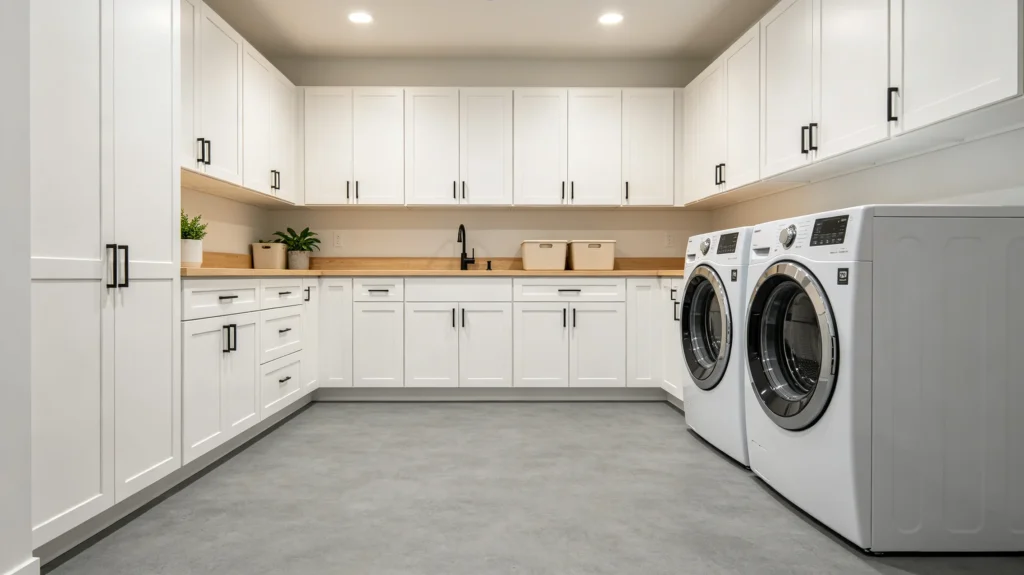
2. SPC and Other Rigid-Core Vinyl
SPC and other rigid-core vinyl flooring are another strong option for laundry rooms.
Rigid-core products combine a harder core with a decorative surface, often in plank or tile formats. Depending on the specific product, they can provide waterproof performance, dimensional stability, and resistance to everyday household wear.
SPC can also provide a different visual experience from sheet vinyl. Wood-look planks can make a laundry room feel more like an extension of the living space, while stone-look designs can create a cleaner contemporary appearance.
Advantages:
- Rigid construction
- Waterproof options are widely available
- Wood-look and stone-look designs
- Good resistance to everyday household wear
- Plank and tile formats provide flexible layout options
- Generally easier to replace individual pieces than a damaged sheet
Limitations:
- Multiple plank or tile joints create more potential water-entry points than a continuous sheet
- Product specifications vary considerably
- Installation must follow the manufacturer’s requirements
- Hard-core products can feel less forgiving underfoot than softer flooring constructions
For a laundry room, the important point is not simply choosing something labeled “SPC.” Check the actual product’s waterproof claim, dimensional stability, wear layer, installation requirements, and suitability for the intended application.
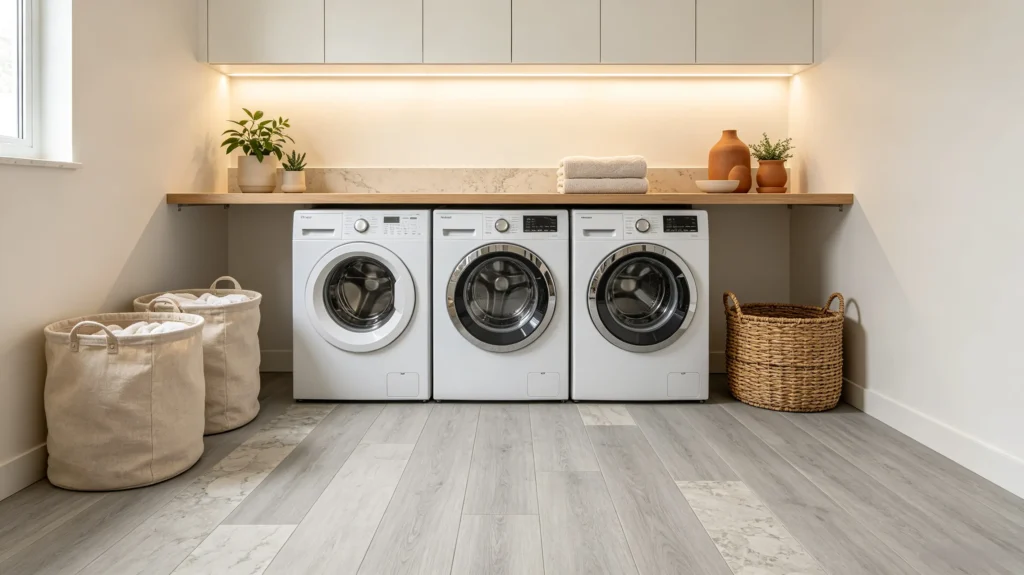
3. Porcelain and Ceramic Tile
Porcelain and ceramic tile remain established choices for laundry rooms because they combine moisture resistance with a hard, durable surface.
Tile can also provide considerable design flexibility. Large-format tiles, wood-look tiles, stone-inspired surfaces, mosaics, and patterned designs can all create very different visual effects.
Advantages:
- Strong and durable surface
- Suitable for areas with regular moisture exposure
- Wide range of colors, patterns, shapes, and sizes
- Works well under heavy appliances
- Easy to clean when properly installed
Limitations:
- Harder underfoot than vinyl
- Can feel cold
- Grout joints require additional maintenance
- Installation is generally more labor-intensive
- A rigid tile surface can be less forgiving if the underlying substrate moves
The Tile Shop’s laundry room content also emphasizes the design flexibility of tile, including different colors, patterns, shapes, and formats.
Tile makes particular sense when long-term durability and a hard, traditional flooring surface are more important than softness or installation simplicity.
4. LVT and LVP
LVT and LVP are widely used in laundry and mudroom applications because they can combine realistic wood or stone appearances with moisture-resistant or waterproof constructions.
The key is to distinguish between products. Not every vinyl floor has the same moisture performance, so the manufacturer’s specifications should be checked rather than assuming that every LVT or LVP product is waterproof. Flooring Canada similarly distinguishes between water-resistant vinyl and waterproof vinyl constructions.
For a laundry room, waterproof products with appropriate installation systems are the relevant category to consider.
Advantages:
- Wide range of wood and stone looks
- Comfortable compared with ceramic tile
- Easy maintenance
- Waterproof options available
- Plank and tile formats allow different layouts
Limitations:
- Performance varies between products
- Seams and transitions need attention
- Flexible or lower-quality products may not offer the same dent resistance as rigid-core constructions
5. Laminate Flooring
Modern laminate products can offer convincing wood visuals and good resistance to everyday wear. Some manufacturers also produce products with improved moisture resistance.
However, laundry rooms present a different level of moisture risk from a typical bedroom or hallway.
The important question is therefore not simply whether a laminate floor is labeled “water-resistant.” Check the specific product’s moisture warranty, installation requirements, and permitted applications.
Some current flooring retailers recommend modern moisture-resistant laminate for laundry rooms, while other flooring guides remain more cautious because prolonged water exposure can damage laminate’s core or joints.
For a room where leaks are a significant concern, waterproof vinyl or properly installed tile provides a more straightforward moisture-focused specification.
6. Engineered Wood
Engineered wood can provide the appearance and character of real wood, but it requires more careful consideration in a laundry room.
Its layered construction gives it greater dimensional stability than solid hardwood, but it is still a wood-based product. Repeated or prolonged water exposure can remain a concern.
If the room has a significant risk of leaks or standing water, flooring specifically designed for wet or moisture-prone environments may be easier to specify.
7. Concrete and Rubber Flooring
Concrete can be suitable for utility areas, basements, or industrial-style interiors. It provides a hard, durable surface, although it can feel cold and unforgiving underfoot.
Rubber is another less conventional option. It can provide durability, comfort, and resistance to water and heavy use, although its visual character is generally more utilitarian than wood-look vinyl or decorative tile.
These options make more sense when the laundry room also functions as a workshop, garage-adjacent utility area, or other high-use space.
Sheet Vinyl vs. SPC vs. Tile for a Laundry Room
For many projects, the decision comes down to these three categories.
| Consideration | Sheet Vinyl | SPC / Rigid-Core Vinyl | Tile |
|---|---|---|---|
| Moisture performance | Excellent when properly specified and installed | Excellent for waterproof products | Excellent when properly installed |
| Number of seams | Relatively few | Multiple plank or tile joints | Grout joints |
| Appliance support | Product dependent | Product dependent | Very good |
| Underfoot feel | Softer | Firm but more resilient than tile | Hard |
| Installation | Requires accurate sheet installation | Often simpler than tile, depending on system | More labor-intensive |
| Design options | Wood, stone, tile, patterns | Wood, stone, tile, plank layouts | Very broad |
| Maintenance | Easy | Easy | Easy, with additional grout care |
| Visual character | Continuous | Plank or tile appearance | Traditional tile appearance |
There is no universal winner.
Choose sheet vinyl when minimizing seams and creating a continuous surface is a major priority.
Consider SPC or another rigid-core vinyl when you want a plank or tile appearance combined with a rigid, waterproof construction.
Choose tile when maximum surface hardness, long-term durability, and extensive design options are more important than underfoot comfort and installation simplicity.
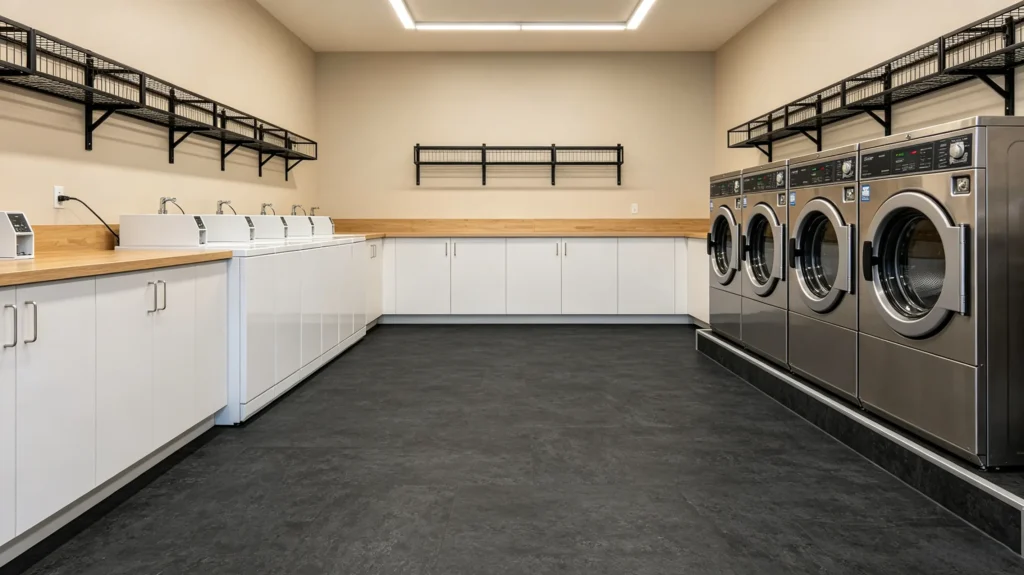
Does Laundry Room Flooring Need to Be Waterproof?
For many laundry rooms, waterproof flooring is a sensible specification because the room has a higher potential for spills, leaks, and standing water than a typical living space.
But “waterproof” should be interpreted carefully.
A waterproof vinyl plank generally means that the flooring product itself can resist water without the core swelling or losing its structural integrity. It does not automatically mean that water cannot reach the subfloor through every joint, edge, transition, or opening.
The complete installation therefore matters.
This includes:
- Flooring joints
- Perimeter edges
- Transitions
- Wall intersections
- Floor penetrations
- Drainage
- Subfloor condition
- Manufacturer installation requirements
If the project involves a significant risk of flooding, the floor assembly and drainage strategy should be considered rather than relying on the flooring material alone.
Should Flooring Go Under the Washer and Dryer?
In many installations, extending the finished flooring beneath the appliances creates a more continuous floor and avoids leaving unfinished areas beneath the machines.
However, the correct installation approach depends on the flooring system, appliance dimensions, floor height, drain pan, access requirements, and manufacturer instructions.
Before installation, consider:
Appliance Footprint
Make sure the finished floor can support the equipment according to the flooring manufacturer’s requirements.
Door and Clearance
Adding a new flooring layer can slightly change finished floor height. Check appliance clearance and door swing before installation.
Drain Pan
If a washer uses a drain pan, make sure the flooring and pan arrangement are compatible and that the pan does not interfere with the finished floor.
Water Connections
Leave sufficient access around water supply lines, drain connections, and other service points.
Floor Drain
If the room has a floor drain, the flooring should be installed according to the appropriate drainage and waterproofing requirements.
The goal is not simply to put flooring beneath the machines. It is to create a finished floor that works with the entire appliance and drainage setup.
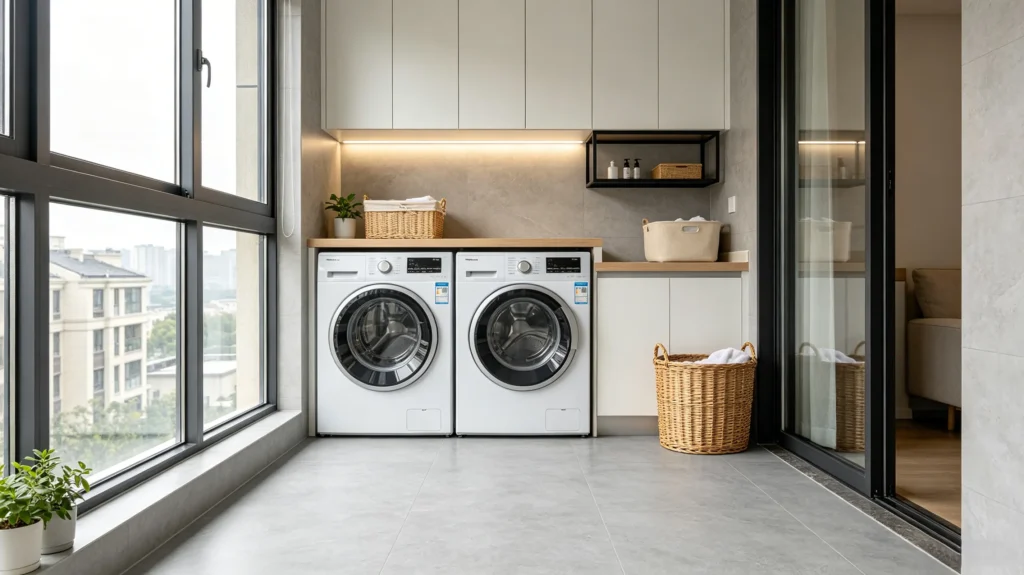
Laundry Room Flooring Ideas
Performance does not mean the laundry room has to look purely functional. Flooring can also help determine the character of the space.
Wood-Look Vinyl for a Warmer Interior
Wood-look sheet vinyl or rigid-core vinyl can make a laundry room feel more connected to adjacent living spaces.
This is particularly useful when the laundry room is open to a mudroom, hallway, or kitchen with wood-look flooring.
Stone-Look Flooring for a Contemporary Space
Stone-inspired vinyl or tile can create a cleaner architectural appearance.
Grey, beige, and other neutral stone looks can also work well with white cabinetry and simple storage systems.
Patterned Tile for a Decorative Floor
A laundry room can be a suitable place for a more distinctive pattern because the floor area is often relatively limited.
Geometric or encaustic-inspired tile can create a visual focal point without dominating a larger living area.
Matching the Adjacent Room
If the laundry room is visible from the kitchen, mudroom, or hallway, using a related flooring color or material can create visual continuity.
The flooring does not have to be identical. Similar tones or complementary textures can achieve a connected appearance without making every room look the same.
What If the Laundry Room Also Serves as a Mudroom?
A combined laundry and mudroom needs to handle even more varied conditions.
In addition to washing-machine leaks and detergent spills, the floor may be exposed to:
- Wet shoes
- Mud
- Outdoor dirt
- Pet traffic
- Heavier foot traffic
- Water from coats and umbrellas
For a combined space, durability, cleaning, slip resistance, and moisture performance become particularly important. Flooring that visually connects the two functions can also make the room feel more intentional rather than dividing it into separate utility zones.
How to Choose the Right Laundry Room Flooring
Instead of choosing a material simply because it appears on a “best flooring” list, start with the conditions of the actual room.
1. Assess the Water Risk
Consider the washing machine, utility sink, floor drain, plumbing connections, and history of leaks.
2. Decide How Important Low-Seam Construction Is
If minimizing potential water-entry points is a priority, sheet vinyl may deserve particular consideration. Plank, tile, and rigid-core systems require closer attention to joints and transitions.
3. Check Appliance Requirements
Review the flooring manufacturer’s requirements for concentrated loads, furniture, appliance feet, and installation.
4. Consider the Subfloor
The condition and flatness of the subfloor can affect the performance and appearance of the finished floor. Some rigid-core systems can tolerate minor imperfections better than more flexible flooring, but this does not eliminate the need for proper subfloor preparation.
5. Match the Maintenance Requirements to the Room
A laundry room should not require complicated daily care. Consider how the flooring should be cleaned and how it responds to detergent, dirt, and moisture.
6. Think About the Rest of the Home
If the laundry room is visible from another living area, consider whether the floor should coordinate with the kitchen, mudroom, hallway, or other adjacent spaces.
7. Check the Actual Product Specifications
Flooring categories contain many different constructions. Verify:
- Waterproof or water-resistant classification
- Wear layer or surface protection
- Dimensional stability
- Installation method
- Subfloor requirements
- Recommended applications
- Cleaning instructions
- Warranty limitations
This is especially important when comparing products that use similar marketing terms but have different constructions.
FAQs
What is the best flooring for a laundry room?
Sheet vinyl, waterproof SPC or other rigid-core vinyl, and porcelain or ceramic tile are among the most practical options. The right choice depends on priorities such as seam reduction, appliance support, comfort, installation, maintenance, and design.
Is sheet vinyl good for a laundry room?
Yes. Sheet vinyl can be a practical choice because its large format can reduce the number of seams, while its easy-clean surface and broad range of designs make it suitable for many laundry room applications. The specific product and installation method should be checked for the intended moisture exposure.
Is SPC flooring suitable for a laundry room?
Waterproof SPC can be suitable for laundry rooms. Its rigid construction can provide good dimensional stability and resistance to everyday impacts, but the specific product’s load limits, installation requirements, and waterproof warranty should be reviewed before installation.
Is tile or vinyl better for a laundry room?
Neither is universally better. Tile provides a hard, durable surface with extensive design options, while vinyl can provide a softer feel, easier installation, and wood- or stone-look designs. Sheet vinyl also has the advantage of fewer seams.
Can you use laminate flooring in a laundry room?
Some modern laminate products are designed with improved moisture resistance, but suitability depends on the exact product. Because laundry rooms have a higher risk of prolonged water exposure, check the manufacturer’s moisture rating, warranty, and approved applications before choosing laminate.
Should flooring go under the washer and dryer?
In many installations, finished flooring extends beneath the appliances, but the correct approach depends on the flooring system, appliance setup, floor height, drain pan, and manufacturer’s installation instructions.
Does laundry room flooring need to be waterproof?
Waterproof flooring is often a practical choice for laundry rooms because leaks and spills are more likely than in many other rooms. However, waterproof flooring alone does not create a completely waterproof room. Seams, edges, transitions, drainage, and the underlying structure also need to be considered.
Final Thoughts
A good laundry room floor needs to do more than look attractive. It should suit the room’s moisture exposure, appliance load, maintenance needs, and installation conditions.
For many projects, the decision comes down to the differences between sheet vinyl, waterproof SPC or rigid-core vinyl, and tile. Understanding how each handles water, seams, appliances, comfort, and design will make it easier to choose a flooring system that works for the actual laundry room rather than simply following a generic “best flooring” list.