Wood look sheet vinyl flooring and wood look vinyl plank flooring both recreate the appearance of natural wood without requiring real timber. The main difference is their format. Sheet vinyl comes in large, continuous rolls, while vinyl plank flooring consists of individual planks designed to resemble wood boards.
Sheet vinyl can provide a more continuous floor surface with fewer seams, while vinyl planks offer more flexibility in plank layouts and individual plank replacement. The right choice depends on the room layout, installation requirements, expected water exposure, maintenance needs, and overall project budget.
What Is Wood Look Sheet Vinyl Flooring?
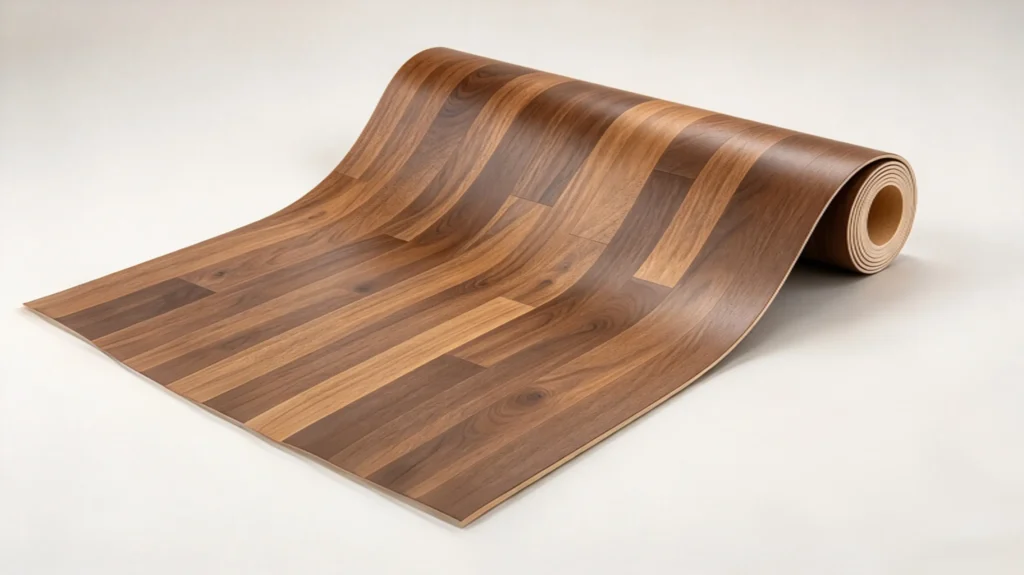
Wood look sheet vinyl flooring is a resilient flooring product supplied in large rolls. Its printed surface reproduces wood grain, knots, color variations, and plank patterns to create the appearance of a wood floor.
Because it comes in broad sheets, it can cover a large floor area with relatively few seams. This makes it a practical option for rooms where a continuous appearance and straightforward routine cleaning are priorities.
Key characteristics include:
- Continuous coverage: Large sheet sizes can reduce the number of seams across a floor.
- Wood-inspired designs: Available patterns can imitate different wood species, tones, and grain styles.
- Flexible installation options: Depending on the product, installation may involve full-spread adhesive, perimeter adhesive, or other approved methods.
- Room-size considerations: The number of seams depends on the roll width, room dimensions, layout, and installation plan.
Sheet vinyl is commonly considered for residential interiors, rental properties, offices, and other commercial spaces where the product specifications suit the expected traffic and maintenance requirements.
What Is Wood Look Vinyl Plank Flooring?
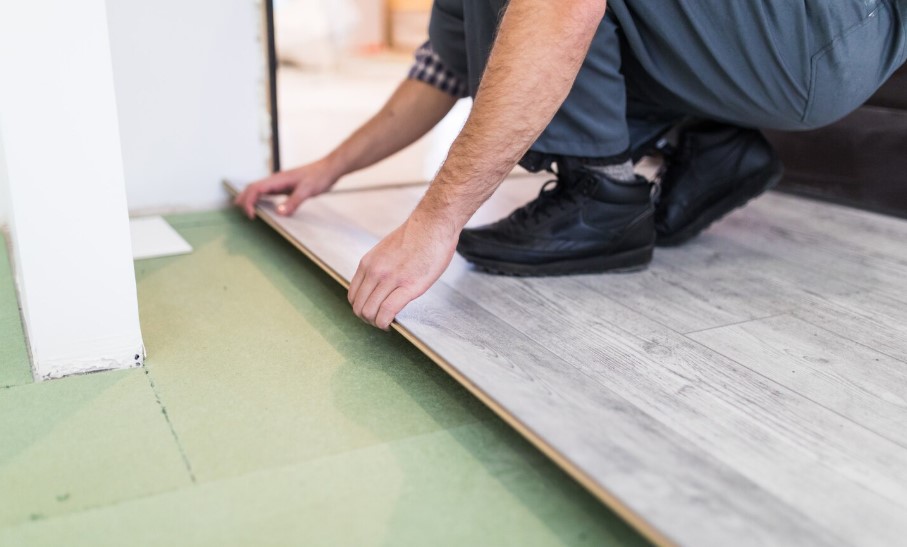
Wood look vinyl plank flooring consists of individual rectangular pieces designed to resemble natural wood boards. Each plank contributes to the overall floor pattern, creating a more distinct board-by-board appearance.
Vinyl plank flooring includes different constructions and installation systems. Luxury vinyl plank (LVP), for example, is one category of vinyl plank flooring. Some products use a click-lock floating installation system, while others are designed for adhesive installation.
Key characteristics include:
- Individual plank format: The floor has visible plank boundaries that resemble the joints between wood boards.
- Flexible layout options: Planks can be arranged in different directions or patterns when the product and installation method allow.
- Localized repairs: A damaged plank may be replaceable without removing the entire floor, although access and repair difficulty depend on the installation system.
- Product-specific construction: Core materials, wear layers, surface textures, thicknesses, and locking systems vary between products.
Vinyl plank flooring is often considered for living rooms, bedrooms, kitchens, offices, and retail interiors where a wood-board appearance is desirable.
Wood Look Sheet Vinyl vs. Vinyl Plank Flooring: 7 Key Differences
1. Appearance and Wood Grain Realism
Both flooring formats can reproduce the appearance of wood, but they create different visual effects.
Wood look sheet vinyl typically uses a printed design across a continuous surface. The quality of the wood effect depends on the print resolution, grain detail, color variation, surface finish, and pattern repetition. In large rooms, repeated patterns may become noticeable if the design lacks sufficient variation.
Vinyl plank flooring creates a more defined board-by-board appearance. Differences in plank color, grain, texture, and dimensions can make the finished floor resemble individual wood boards more closely. Embossed surfaces and registered textures can further enhance the visual effect.
However, the format alone does not determine realism. A well-designed sheet vinyl product can look more convincing than a low-quality vinyl plank product.
Choose based on: The actual surface design, pattern repetition, texture, and appearance across a representative floor area. If the project requires a realistic wood-board effect, request product samples or installation images before making a decision.
2. Seams and Overall Floor Appearance
The number and placement of seams are important differences between the two formats.
Sheet vinyl is supplied in large rolls, so a room may be covered with one piece or a small number of pieces, depending on the roll width and room dimensions. Fewer seams can create a more continuous appearance and reduce the number of joints that require attention during installation and maintenance.
Vinyl plank flooring contains joints between individual planks by design. These joints create the familiar appearance of separate wood boards and allow the installer to establish a specific laying direction or pattern.
Neither format guarantees a seamless or flawless finish. Sheet vinyl may require seams in larger or irregularly shaped rooms, while plank joints must be fitted correctly to achieve an even appearance.
Choose sheet vinyl when a continuous surface and fewer seams are priorities.
Choose vinyl planks when visible board definition and a more structured wood-floor pattern are important to the design.
3. Installation Methods and Subfloor Preparation
Installation requirements affect labor costs, project schedules, and the final floor quality.
Sheet vinyl installation depends on the product and the selected fixing method. Some products require adhesive across the entire subfloor, while others permit alternative installation methods. Accurate measuring, cutting, seam positioning, and handling of large sheets are important, especially in rooms with corners, doorways, and built-in fixtures.
Vinyl plank flooring also has different installation systems. Click-lock planks are commonly installed as floating floors, while glue-down planks are bonded to the prepared subfloor. Each system has specific requirements for expansion gaps, adhesive, underlayment, and installation conditions.
Subfloor preparation matters for both formats. Unevenness, cracks, moisture, dust, and other surface defects can affect the finished result. Flexible sheet vinyl may show imperfections beneath it, while vinyl planks can also develop visible or functional problems if the substrate is unsuitable.
Before choosing either format, check:
- Whether the existing floor must be removed.
- Whether the subfloor needs leveling or moisture treatment.
- Which adhesive, underlayment, or installation system the manufacturer approves.
- Whether professional installation is needed for seams, transitions, and complex room layouts.
- How much material is required, including any cutting waste.
Do not assume that one format is always easier or cheaper to install. The room layout, product specifications, installer experience, and local labor rates all affect the result.
4. Water Resistance and Seam Management
Water resistance is an important consideration for kitchens, bathrooms, laundry rooms, and other areas exposed to spills or moisture.
Many sheet vinyl and vinyl plank products have water-resistant or waterproof surface and core constructions. However, the performance of the complete installed floor depends on more than the material itself.
Sheet vinyl can reduce the number of joints where water may enter, particularly when a room can be covered with a single sheet. Seams, edges, perimeter details, and transitions still require appropriate installation. Water may also reach the subfloor through poorly sealed edges or other openings.
Vinyl planks have joints between individual pieces. Depending on the product and installation system, water may pass through these joints or reach the subfloor around the perimeter. Waterproof plank construction does not automatically make the entire installed floor waterproof.
For moisture-prone spaces, confirm the manufacturer’s stated water-resistance performance and installation requirements. Also check whether the product is approved for the intended room and whether additional waterproofing is required beneath the flooring.
Choose based on: The expected water exposure, the number of seams, edge and transition details, and the manufacturer’s installation guidance. Neither format should be treated as a substitute for a suitable waterproofing system where one is required.
5. Repair and Replacement
Repairability can influence long-term maintenance costs, particularly in commercial spaces or properties with frequent use.
With vinyl plank flooring, a damaged plank may be replaced individually. This can be convenient when the damage is localized, but the process depends on the installation system. A click-lock floor may require removing surrounding planks to access the damaged piece, while a glued-down plank may need to be cut out and replaced carefully. Matching the original color and pattern can also be difficult if the product has changed or the original batch is unavailable.
Sheet vinyl repairs can be more challenging because the floor is installed in larger sections. A small damaged area may require a patch, and the repair can remain visible if the pattern, color, or texture does not align perfectly. Extensive damage may require replacing a larger section or the entire sheet.
Choose vinyl planks when localized replacement is a major maintenance priority.
Consider sheet vinyl when minimizing seams and maintaining a continuous floor appearance are more important than replacing individual pieces.
For either option, retaining spare material and documenting the product model, color, and batch information can make future repairs easier.
6. Material Cost and Total Installed Cost
The initial price of flooring is only one part of the total project cost.
Sheet vinyl and vinyl plank flooring are available across a range of price points. Actual costs depend on product quality, surface design, wear layer, construction, thickness, brand, order quantity, and market.
Installation costs can differ just as much. Sheet vinyl may require careful measuring, large-sheet handling, seam work, and specialist installation. Vinyl planks may involve additional substrate preparation, adhesive, underlayment, or more labor-intensive layouts.
Other costs to consider include:
- Subfloor leveling and repairs.
- Adhesive, underlayment, and installation accessories.
- Cutting waste and spare material.
- Skirting, transitions, and edge finishing.
- Future repairs and replacement.
- Cleaning and maintenance requirements.
A lower material price does not necessarily mean a lower total installed cost. Similarly, a higher-priced product is not automatically more durable or suitable for the application.
For an accurate comparison, request quotations based on the same floor area and clearly defined preparation, installation, and finishing requirements.
7. Maintenance and Long-Term Performance
Both flooring formats are generally designed for routine cleaning, but maintenance requirements depend on the product’s surface and installation details.
Sheet vinyl provides a relatively continuous surface when installed with few seams. This can simplify routine cleaning, although dirt and moisture can still accumulate around edges, seams, and transitions.
Vinyl plank flooring is also straightforward to maintain when the correct cleaning methods are used. Its joints may require attention during cleaning, and damaged or separated planks should be addressed according to the manufacturer’s guidance.
For both formats, long-term performance depends on factors such as:
- Wear layer thickness and surface treatment.
- Resistance to scratches, stains, and abrasion.
- Furniture loads and rolling traffic.
- Subfloor stability and installation quality.
- Exposure to sunlight, heat, moisture, and cleaning chemicals.
- Compliance with the manufacturer’s maintenance instructions.
Neither sheet vinyl nor vinyl plank flooring is inherently more durable in every situation. Compare the specifications relevant to the intended use rather than relying on format or total thickness alone.
Which Flooring Is Better for Different Spaces?
The best format depends on how the space will be used, its layout, and the appearance required.
| Application | Wood Look Sheet Vinyl | Wood Look Vinyl Plank |
|---|---|---|
| Living rooms | Suitable when a continuous surface and simple wood-inspired design are preferred | Suitable when distinct wood-board patterns are a priority |
| Bedrooms | A practical option when easy cleaning and fewer seams are desirable | A good option for defined plank layouts and varied wood designs |
| Kitchens | Can reduce the number of floor joints, subject to suitable installation | Offers wood-board styling, but joints and edges need appropriate installation |
| Bathrooms and laundry rooms | May suit moisture-prone areas when the product and installation system are approved for the application | May suit these areas when the product is approved and the complete installation manages moisture appropriately |
| Offices and retail spaces | Worth considering for large areas where a continuous appearance is preferred | Useful when plank patterns and localized repair options are priorities |
| Rental properties | Can be suitable when the product’s cost, maintenance, and replacement requirements align with the property | Can be suitable when individual plank replacement is a practical maintenance advantage |
This comparison is a starting point rather than a universal rule. Product specifications, local building requirements, subfloor conditions, and installation quality should guide the final selection.
How to Choose the Right Wood Look Vinyl Flooring
Before selecting a product, evaluate the following factors.
1. Define the design objective. Decide whether you prefer a continuous wood-inspired surface or a floor that visibly resembles separate boards. Compare color, grain variation, texture, and finish under the lighting conditions of the actual space.
2. Assess the room layout. Measure the floor area, including alcoves, doorways, and other irregular sections. For sheet vinyl, check roll width and likely seam locations. For vinyl planks, consider plank dimensions, laying direction, and the amount of cutting required.
3. Confirm moisture requirements. Identify whether the space experiences occasional spills, frequent cleaning, or sustained moisture exposure. Verify the product’s suitability and the installation details needed for the application.
4. Review installation requirements. Check the approved fixing method, subfloor flatness, moisture limits, adhesive compatibility, and any underlayment requirements. Obtain an installation quotation that includes preparation and finishing work.
5. Compare performance specifications. Look at the wear layer, surface treatment, indentation and abrasion performance, applicable certifications, and warranty conditions. Choose specifications that match the expected traffic and maintenance routine.
6. Calculate the total project cost. Compare material, preparation, installation, accessories, cutting waste, and potential maintenance expenses. This provides a more useful basis for decision-making than comparing product prices alone.
7. Request samples and technical documentation. Examine the actual surface finish, wood pattern, and color before placing a large order. For commercial or multi-unit projects, confirm consistency between batches, packaging details, lead times, and installation guidance.
Explore Wood Look Sheet Vinyl Flooring from TIMOTECH
Wood look sheet vinyl flooring is worth considering for projects that prioritize continuous floor coverage, fewer seams, and wood-inspired designs. The appropriate product depends on the room layout, installation conditions, appearance requirements, and expected use.
TIMOTECH offers sheet vinyl flooring solutions for project applications. Contact timmy.wu@timotechs.com to discuss your flooring requirements and explore suitable options for your project.
FAQs
Is wood look sheet vinyl flooring better than vinyl plank flooring?
Neither format is universally better. Sheet vinyl can reduce the number of seams and create a more continuous appearance, while vinyl planks offer distinct board patterns and may allow individual pieces to be replaced. The right choice depends on the room, installation requirements, moisture exposure, and maintenance priorities.
Is wood look sheet vinyl flooring waterproof?
Some sheet vinyl products are designed to resist water, but performance varies by product. Seams, edges, transitions, and installation details affect how the complete floor handles moisture. Check the manufacturer’s specifications before using the flooring in wet areas.
Which is easier to repair, sheet vinyl or vinyl plank flooring?
Vinyl plank flooring often allows localized replacement, although surrounding planks may need to be removed depending on the installation system. Sheet vinyl can be harder to repair invisibly because its printed pattern must align with the surrounding surface.
Does wood look sheet vinyl flooring look realistic?
Yes. Quality sheet vinyl can reproduce wood grain, color variation, and surface texture convincingly. Realism depends on print quality, pattern repetition, embossing, and finish rather than the sheet format alone.
Which is more cost-effective for a commercial project?
The answer depends on material pricing, installation labor, subfloor preparation, room layout, and future maintenance. Sheet vinyl may reduce seams across large areas, while vinyl planks may offer advantages when localized replacement is important. Compare total installed costs and product performance for the specific application.