Yes, waterproof wall panels can be an effective solution for bathrooms, shower areas, and other moisture-prone spaces, but the term “waterproof” should not be interpreted as meaning that every panel or installation is completely impervious to water. Actual performance depends on the panel material, surface and core construction, joints, edges, and installation method.
For this reason, choosing waterproof wall panels requires more than comparing product appearance or material names. The level of water exposure and the complete wall system should also be considered.
Are Waterproof Wall Panels Any Good?
Waterproof wall panels can be a practical alternative to traditional wall finishes in areas where moisture resistance and easy maintenance are important.
Their main advantages include:
- Resistance to moisture and water exposure, depending on construction
- Easy-to-clean surfaces
- Fewer visible joints than many tile installations
- A wide range of colors, patterns, and textures
- Relatively straightforward installation with suitable systems
- Lower routine maintenance requirements than some traditional finishes
However, waterproof wall panels are not automatically the best option for every application. Performance depends on the material, product construction, installation conditions, and the level of moisture exposure.
For a bathroom renovation, for example, a panel designed for general interior walls should not automatically be assumed to be suitable for a continuously wet shower area.
Are Waterproof Wall Panels Really Waterproof?
Some wall panels are specifically designed to provide high water resistance, but the waterproof performance of a finished wall depends on more than the panel itself.
A complete installation may include several potential points where water can penetrate:
- Panel joints
- Corners
- Edges
- Around pipes and fixtures
- Fastener penetrations
- Connections between panels and other surfaces
The panel material also matters. A water-resistant surface does not necessarily mean that the entire panel construction has identical moisture resistance.
This distinction is particularly important for bathroom and shower applications.
Panel waterproofing vs. wall-system waterproofing
A panel can resist water while the completed wall assembly still requires appropriate sealing and installation.
Therefore, when evaluating a waterproof wall panel, check:
- Panel material and core construction
- Water-resistance testing
- Joint and edge design
- Approved applications
- Installation and sealing requirements
This gives a more accurate picture of how the product will perform in an actual wet environment.
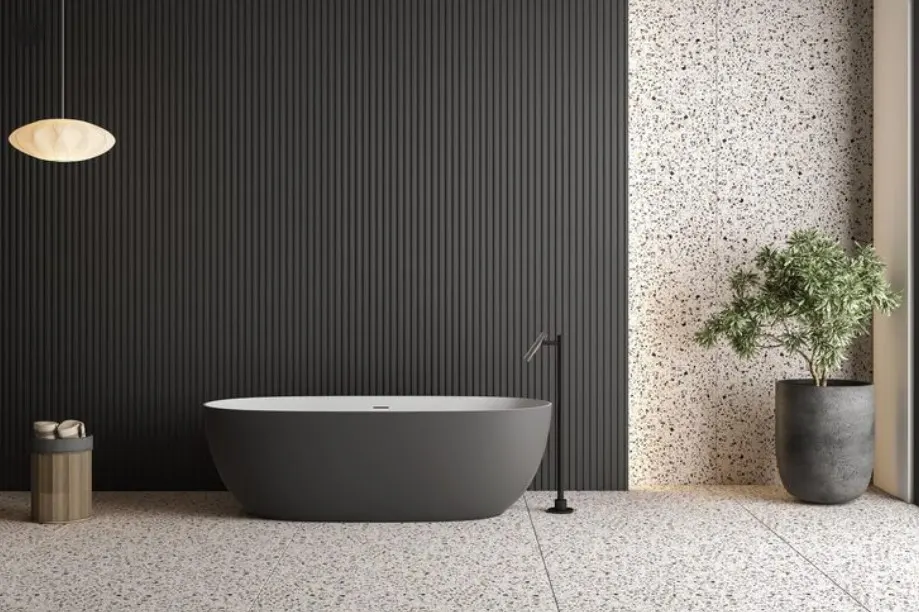
Is PVC Wall Panel Waterproof?
PVC wall panels are highly resistant to water because PVC itself has very low water absorption. This makes PVC a common material for wall coverings in bathrooms, utility areas, and other moisture-prone interiors.
However, whether a complete PVC wall panel installation is waterproof depends on the specific product and installation system.
The following factors still matter:
- Panel construction
- Surface finish
- Joint design
- Edge treatment
- Adhesive or sealant compatibility
- Installation quality
So, it is more accurate to say that PVC provides strong water-resistant characteristics than to assume that every PVC wall panel installation is automatically 100% waterproof.
Is PVC Board 100% Waterproof?
PVC is highly water-resistant, but “100% waterproof” should be evaluated at the complete product and installation level.
The PVC material itself does not absorb water in the same way as many porous materials. However, water can still reach the wall substrate through poorly sealed joints, corners, penetrations, or damaged areas.
For this reason, a bathroom wall system should be evaluated based on both the panel’s water-resistance properties and its installation details.
If a product is intended for direct shower or wet-area use, its technical documentation and installation instructions should specifically support that application.
What Are the Disadvantages of Waterproof Wall Panels?
Waterproof wall panels have several practical advantages, but they also have limitations.
Installation still matters
A panel may have good water resistance, but poorly treated joints, corners, and penetrations can compromise the finished installation.
Not every panel is suitable for every wet area
“Waterproof wall panel” is a broad product description. Different materials and constructions can have different performance levels.
Surface damage can be difficult to repair
If a panel is seriously scratched, cracked, or otherwise damaged, repairing the affected area may be more difficult than repairing a painted wall.
Appearance is a matter of preference
Modern wall panels can reproduce wood, stone, marble, and other finishes, but some projects may still require the appearance and tactile characteristics of natural tile or stone.
Initial cost varies
Panel systems are available across different price ranges. The most economical product is not necessarily the most appropriate for an area with demanding moisture or traffic conditions.
The important point is that these limitations do not make waterproof wall panels unsuitable. They simply mean that the panel and installation system should match the application.
Are Waterproof Wall Panels Better Than Drywall?
For moisture-prone areas, a purpose-designed waterproof wall panel can provide advantages over standard drywall, but neither material is universally better.
| Consideration | Waterproof Wall Panels | Standard Drywall |
|---|---|---|
| Moisture resistance | Generally high, depending on product | Limited |
| Cleaning | Usually easy | Depends on surface finish |
| Surface finishing | Factory-finished options available | Usually requires finishing |
| Installation | Panel-based installation | Requires joint treatment and finishing |
| Design options | Wide range of decorative finishes | Requires paint or other finish |
| Wet-area suitability | Depends on product specification | Requires an appropriate wall system |
For bathrooms and other areas exposed to regular moisture, the relevant question is not simply whether one material is better.
Instead, consider:
How much water will the wall be exposed to, and is the selected system designed for that environment?
Waterproof Wall Panels vs. Bathroom Tiles
Tiles remain a widely used bathroom wall finish, but waterproof wall panels offer a different approach to wall finishing.
Waterproof Wall Panels
They can provide:
- Large-format surfaces
- Fewer joints
- Faster installation in suitable conditions
- Easy routine cleaning
- A variety of decorative finishes
Tiles
They can provide:
- Extensive design flexibility
- Many colors, sizes, and patterns
- A familiar bathroom finish
- Long-term durability when correctly installed and maintained
The difference is particularly noticeable at the joints. Tile installations can contain numerous grout lines, while large wall panels can reduce the number of visible joints.
However, wall panels still require properly sealed connections, particularly around corners, fixtures, and other penetrations.
Neither option is automatically better for every bathroom. Water exposure, installation requirements, appearance, maintenance, and project budget should all be considered.
What Is the Cheapest Way to Waterproof a Bathroom Wall?
There is no single waterproofing method that is always the cheapest.
The total cost depends on:
- Existing wall condition
- Area being treated
- Required waterproofing level
- Material cost
- Labor
- Surface preparation
- Installation method
- Long-term maintenance
For example, applying a low-cost surface coating may have a lower initial material cost, but it does not necessarily provide the same wall-covering function or long-term performance as a purpose-designed wet-area panel system.
Likewise, installing panels over a suitable existing surface may reduce some finishing work, but the installation still needs appropriate preparation and sealing.
The most economical solution is usually the one that meets the required moisture protection without adding unnecessary preparation, installation, or maintenance costs.
What Can I Put on a Wall to Make It Waterproof?
Several solutions can be used depending on the wall and the level of water exposure.
Waterproof wall panels
Purpose-designed panels can provide both wall protection and a finished decorative surface.
Tile systems
Tiles can be used with an appropriate waterproofing system behind them, particularly in shower areas.
Waterproof coatings
Certain coatings can provide moisture protection for specific applications, but they do not necessarily replace a complete wet-area waterproofing system.
The important distinction is that covering a wall with a water-resistant material does not automatically make the entire wall waterproof.
The substrate, joints, corners, penetrations, and installation details must also be considered.
What Is the Best Waterproofing for Bathroom Walls?
There is no single best solution for every bathroom.
The appropriate system depends on how the wall is exposed to water.
For shower walls
The wall is exposed to direct and repeated water, so the selected wall system should be specifically suitable for wet-area use and properly sealed at joints, corners, and penetrations.
For general bathroom walls
The main requirements may be resistance to humidity, splashes, cleaning, and occasional moisture rather than continuous direct water exposure.
For renovation projects
Installation conditions can become particularly important. A solution that can be installed efficiently over a suitable existing surface may have practical advantages.
Therefore, the best choice should be based on water exposure, substrate condition, installation requirements, maintenance, and product specifications, rather than material name alone.
PVC vs. WPC Wall Panels: Which Is Better?
Neither PVC nor WPC is universally better. The appropriate material depends on the intended application and the specifications of the individual product.
| Feature | PVC Wall Panels | WPC Wall Panels |
|---|---|---|
| Moisture resistance | Generally high | Depends on construction |
| Appearance | Wide range of finishes | Often wood-inspired |
| Maintenance | Generally easy | Generally easy |
| Typical applications | Interior and moisture-prone areas | Interior decorative applications |
| Selection priority | Product specifications and wet-area suitability | Product specifications and wet-area suitability |
For areas exposed to frequent or direct water, it is important to evaluate the actual water-resistance performance of the product rather than choosing solely according to whether it is called PVC or WPC.
Construction, surface treatment, joints, and installation can all affect the final result.
Can Waterproof Wall Panels Be Painted?
Some waterproof wall panels can be painted, but not all are designed to accept paint.
Whether painting is appropriate depends on the panel’s surface material and finish. A smooth decorative surface may require specific surface preparation, primer, and paint compatibility.
Before painting a waterproof wall panel, check the manufacturer’s recommendations for:
- Surface preparation
- Compatible primers
- Paint type
- Adhesion requirements
- Whether painting is permitted at all
If the panel is supplied with a finished decorative surface, painting may also be unnecessary.
What Can I Use to Cover My Bathroom Walls?
Several wall-covering options can work in a bathroom, depending on the location and water exposure.
Waterproof wall panels
A practical option when easy cleaning, moisture resistance, and a finished decorative surface are priorities.
Ceramic or porcelain tiles
Suitable for bathrooms when installed as part of an appropriate waterproofed system and when a traditional tiled appearance is preferred.
Waterproof coatings
Can be useful in certain renovation applications, although they do not provide the same type of physical wall covering as panels or tiles.
For shower areas, the selected system should be designed for direct water exposure rather than simply for general bathroom humidity.
How to Choose Waterproof Wall Panels
Once the application is clear, several product characteristics should be compared.
1. Check the Material and Core
PVC, WPC, SPC, and other panel constructions can have different properties.
Do not assume that two panels with the same “waterproof” label will perform identically.
2. Consider the Level of Water Exposure
A wall next to a bathroom sink has different requirements from a wall inside a shower.
Identify whether the panel will face:
- Humidity
- Occasional splashes
- Frequent cleaning
- Direct shower water
- Continuous moisture
3. Check the Joint and Edge System
The weakest point of a wall installation may not be the middle of the panel.
Pay particular attention to:
- Panel joints
- Corners
- Edges
- Pipe openings
- Fixture connections
4. Review Surface Performance
For high-use areas, consider:
- Scratch resistance
- Stain resistance
- Cleaning requirements
- Surface hardness
- Chemical resistance where relevant
5. Confirm Installation Requirements
Check whether the panels require:
- Adhesive
- Mechanical fixing
- Sealant
- Specific substrate preparation
- Expansion allowances
Following the manufacturer’s installation requirements is essential to achieving the intended performance.
6. Check Technical Documentation
For commercial or project applications, review available test reports, certifications, product specifications, installation instructions, and warranty conditions.
This provides a more reliable basis for selecting a waterproof wall panel than appearance or material name alone.
FAQs
Are waterproof wall panels any good?
Yes, waterproof wall panels can be an effective option for bathrooms and other moisture-prone areas. They offer moisture resistance, easy cleaning, and a wide range of decorative finishes. Their suitability depends on the panel construction, water exposure, installation method, and whether the product is specifically designed for the intended application.
Is PVC wall panel waterproof?
PVC wall panels are highly resistant to water because PVC has very low water absorption. However, the waterproof performance of a complete installation also depends on joints, edges, corners, penetrations, and sealing. Always check the manufacturer’s specifications when selecting panels for direct wet-area applications.
Is PVC board 100% waterproof?
PVC itself is highly water-resistant, but the complete wall system cannot be judged by the board material alone. Joints, edges, penetrations, installation quality, and the specific panel construction can affect water resistance. For wet areas, select a product that is specifically tested and approved for the intended application.
What are the disadvantages of waterproof wall panels?
Potential disadvantages include installation requirements, limited repairability when a panel is severely damaged, and differences in performance between products. Not every waterproof wall panel is suitable for direct shower exposure. The panel material, construction, joint system, and intended application should be checked before installation.
Can waterproof wall panels be painted?
Some waterproof wall panels can be painted, but this depends on the surface material and finish. Smooth decorative panels may require specific preparation and a compatible primer and paint. Check the manufacturer’s recommendations before painting, as some finished surfaces are not designed to be repainted.
Which is better, PVC or WPC?
Neither is universally better. PVC is commonly valued for its moisture resistance and practical maintenance, while WPC is often selected for its decorative appearance and specific construction characteristics. For wet areas, compare the actual water-resistance specifications and intended applications of the individual products rather than choosing based only on the material name.
Conclusion
Waterproof wall panels can be a practical choice for bathrooms and other moisture-prone spaces, but the panel material is only one part of the equation. Water exposure, core construction, joints, edges, installation, and product specifications all affect the final performance.
If you are comparing waterproof wall panel options for a specific project, evaluate the complete wall system and intended application rather than relying on the word “waterproof” alone.